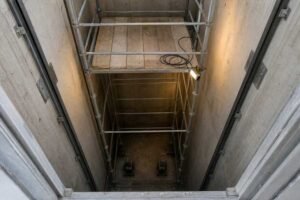
Lift a floor plate at the top landing, shine a torch down, and the first thing you see is not a staircase. It is the underside of the steps — flat, ribbed, running away downhill. Below them sit two chains, a film of black oil, and a square steel tube carrying the whole machine. That is the inside of an escalator, and it looks nothing like the machine people picture.
So what’s inside an escalator? Four groups of parts: a truss, the steps and the chain that pulls them, two tracks that decide where those steps go, and a drive with its handrail.
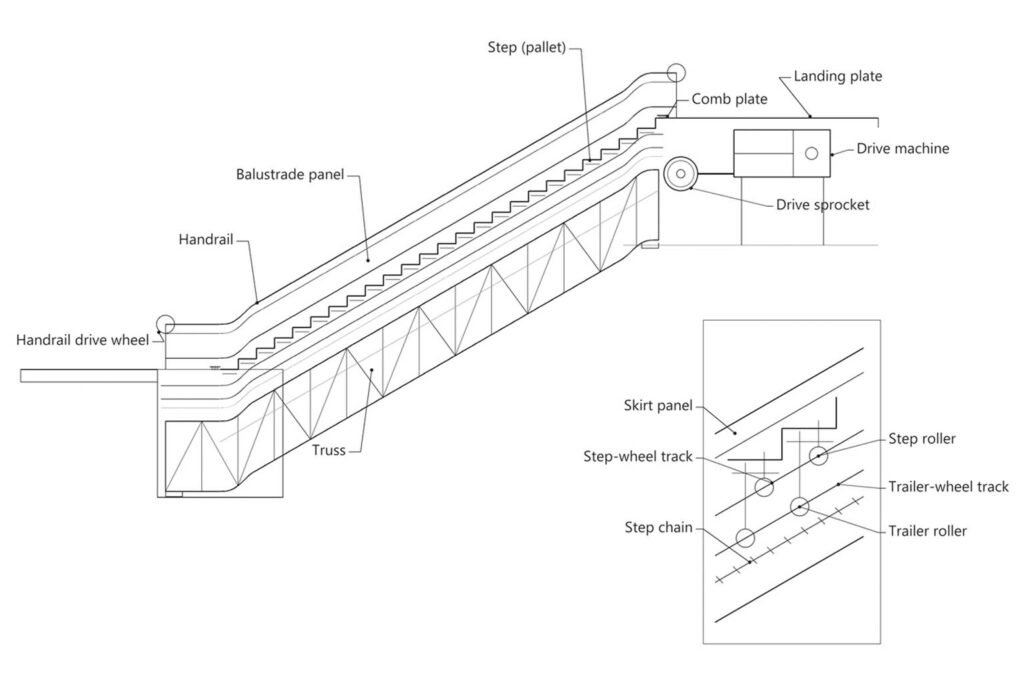
The table below is the escalator parts list, in the order you meet it from the landing plate down. Every machine is built from the same escalator basic components; a full escalator all parts name list rarely runs past these ten rows. Column three puts parts of escalator and its function on one line — the sentence you need to describe a fault to someone not standing beside you. There is no name for the space itself: the phrase an escalator inside called leads back to “under the steps”. What an escalator parts name is worth is exactly this. Every escalator parts called list starts here.
| Part | What it does | Where it sits |
|---|---|---|
| Truss | Carries every load to the two ends | Full length, under the steps |
| Step (pallet) | Carries people; four wheels under each step | Runs the tracks in a closed loop |
| Step chain | Pulls the steps; its pins are the step axles | One on each side |
| Step-wheel track / trailer-wheel track | Set the wheel path, flatten the steps at both ends | Inside the truss |
| Drive machine | Motor, gearbox, brake | Upper station, on most machines |
| Drive sprocket and main chain | Passes torque from the machine to the step chain | Upper station |
| Handrail and handrail drive | Gives a handhold; driven through its own friction wheel | Inside the balustrade |
| Comb plate and comb bearer | Meshes with the step cleats, closes the gap at each landing | Both landings |
| Skirt panel and skirt guard | Closes the side of the step path; a guard switch behind it | Both sides |
| Safety switches | Stop the machine when a gap is forced | Spread through the machine |
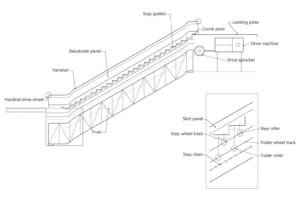
Read the drawing with the table open. The escalator components diagram is the same machine in section, and every part has a leader line in the escalator parts diagram. The lower panel repeats the incline at three times the scale — the only way an escalator mechanism diagram can show both tracks and all four wheels of one step.
What You See When a Landing Plate Comes Up
Start at the top: on most machines the plate lifts out, and that is the normal way in.
The first part under it is the comb plate and its bearer, the toothed strip that steps disappear beneath. Directly behind is the return run: the same steps, upside down, travelling back to the bottom landing. Only the upper face is the one people stand on.
Then the moving parts — the chain on each side, the rollers on it, the two tracks those rollers run on — and a film of oil over everything below them. At the bottom of the opening, the lower chord of the truss: a square steel tube doing nothing visible, holding everything up.
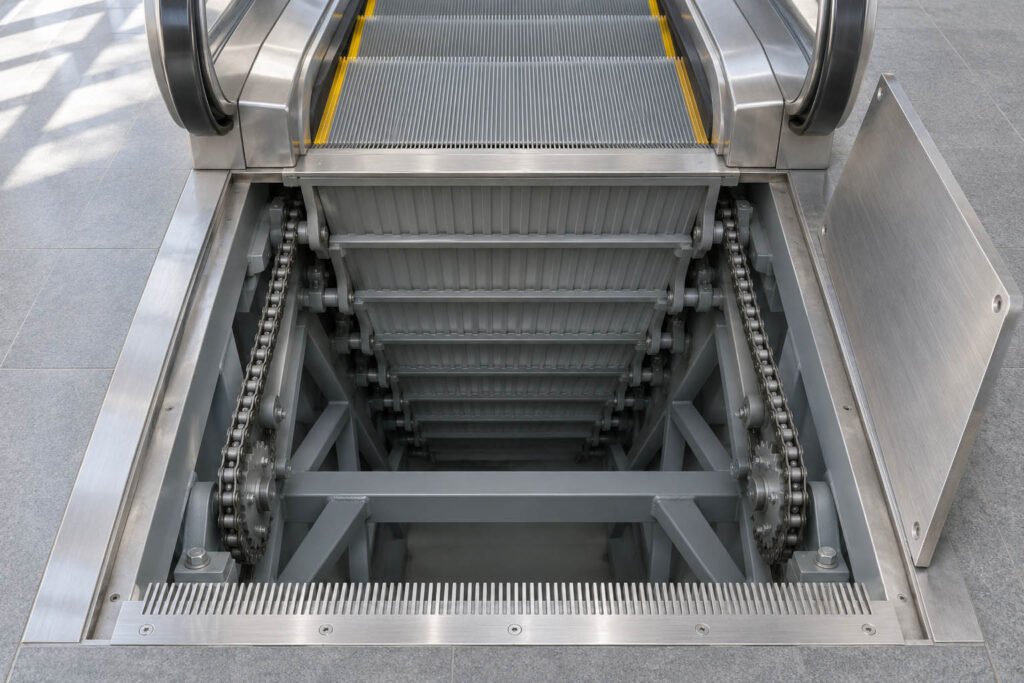
That is the whole view underneath an escalator, and there are only three ways in: the landing plates, a balustrade with one panel off, and a machine with a glass truss. What does an escalator look like underneath with the steps out? A bare truss, two tracks and a drive.
The Truss Is the Box Everything Hangs From
Seen from above, the inside of an escalator looks like a room. It is a bridge. The escalator truss is two side trusses joined by cross braces, and it is the only part that touches the building. Both ends land on supports built into the floor structure; nothing lands in between. A twelve-metre escalator is a twelve-metre span.
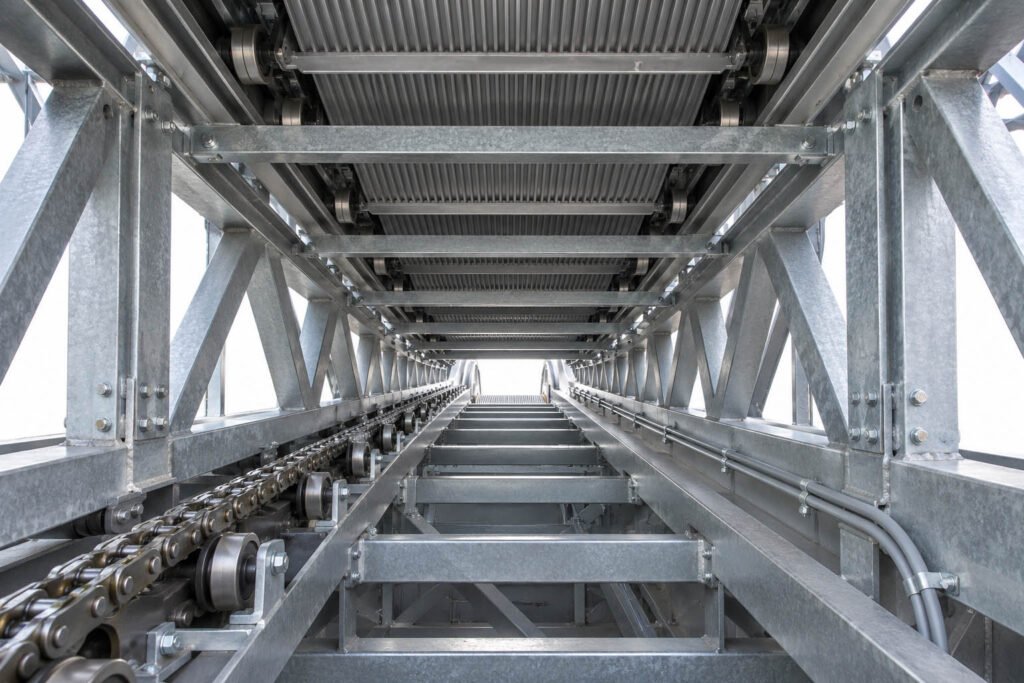
So an escalator is not a lift shaft laid on its side. The truss is not enclosed, it is not a wall, and it carries no building load. It needs no pit along its length: at the lower end, a shallow recess for the return curve and a sump is all the escalator pit dimensions come to. The escalator pit depth is set by the return curve, not the rise.
Do the geometry once. A 4.5 m rise needs about 7.8 m of horizontal run at 30° and 6.4 m at 35° — 1.4 m of floor saved, for a steeper ride. Add a landing at each end for the total length.
After that the escalator anatomy stops being a mystery. The escalator truss support at each end is a steel or concrete bracket, and the escalator inner workings hang from those two points.
The Steps Are Not Boxes on a Belt
A step is one casting or pressing with four wheels, not two. The front pair sits on a narrow axle and rides the step chain; the rear pair is set wider and rides a second track of its own.
That is the whole escalator mechanism. In the incline the tracks sit furthest apart, which holds the rear of each step lower than the front and forces the step level, in the shape of a staircase. At each landing they come back together, the wheels line up, and the step flattens into a platform. Nothing hinges: the track does the work.
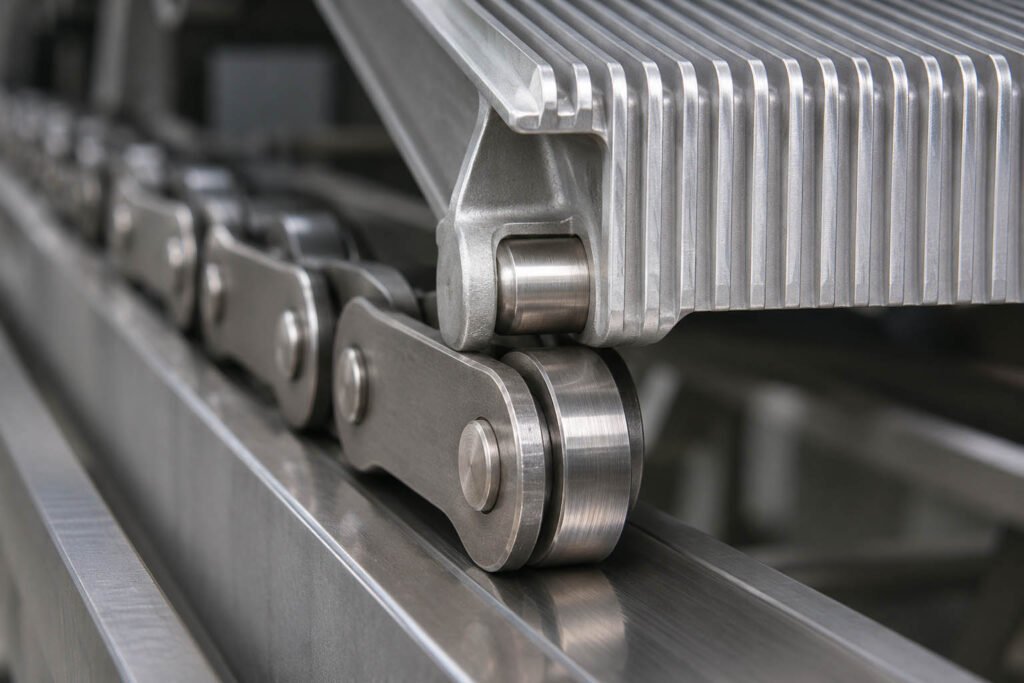
Each step is cleated on tread and riser, and the cleats are what the comb meshes with. The escalator step parts name list is short — tread, riser, cleats, axle, two step rollers, two trailer rollers. Count the wheels under one step: four is correct, two means something else. The escalator step chain does a second job: it holds the spacing between steps fixed, which is why chain wear shows at the landings first.
The return run is the same steps upside down — the part of how does an escalator work that short explanations leave out. The escalator internal mechanism is a loop of rigid steps on rails, and the rails decide the shape.
Two Tracks, One Loop
The two tracks have separate jobs. The step-wheel track sets the front of the step; the trailer-wheel track sets the rear. Both are fixed to the truss and shaped at each end — to flatten the step, then to carry it round the return curve.
The working principle of escalator layout is in that shaping. Because the rear wheel is pulled down in the incline and released at the landing, one loop of chain gives both a staircase and a flat platform, with nothing to switch between them.
The curves are where the load is highest: a roller in a transition changes direction under the weight of a person, thousands of times a day. When a machine starts to sound different, ask where — in the straight incline, or at a transition. The escalator working mechanism tells you why that matters.
The Drive Sits at One End
On most machines the drive is at the upper landing: a motor, a gearbox — worm or helical — a brake, and a drive sprocket pulling the step chain. Some designs run a main chain from gearbox to sprocket; others mount the sprocket on the output directly.
Ask which motor is used in escalator drives and the answer is nearly always a standard three-phase AC motor, with the gearbox turning it into the torque the machine needs at half a metre a second. The escalator motor location follows the same logic: heavy parts where the truss is deepest, and where they can be reached through a landing plate. It is also why the top is the warm end.
The handrail drive often sits at the other end, on a long shaft or its own chain.
The Handrail Has Its Own Drive
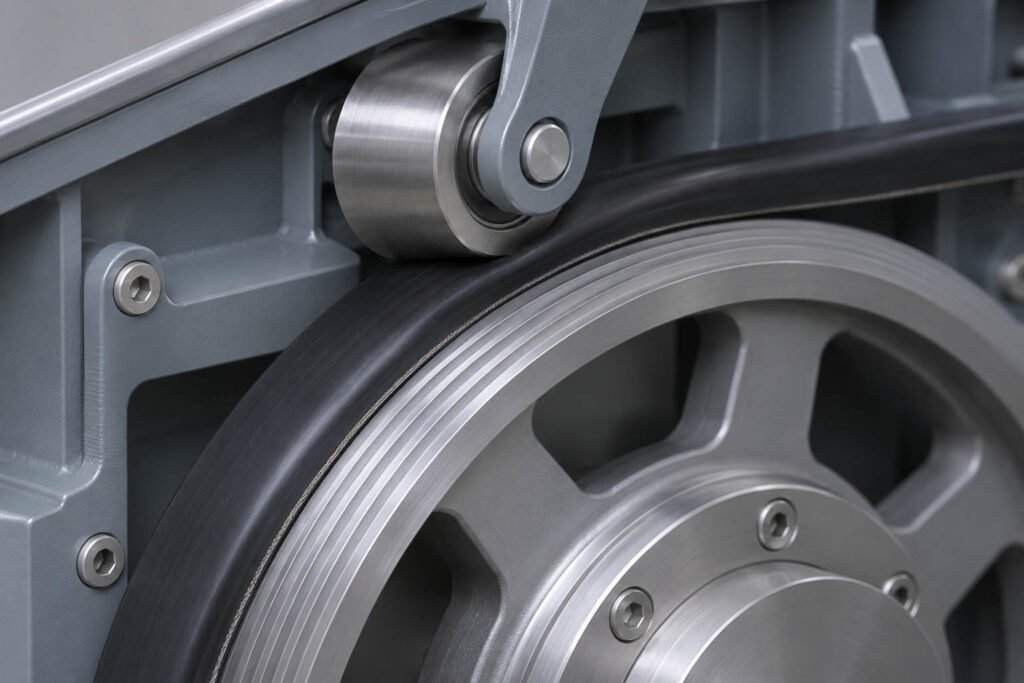
The handrail is not a rubber strip. It is a belt in four layers: a slider ply of cotton or synthetic fabric inside, a tension member of steel cable or tape, a bonding layer of treated rubber, and the cover people hold. That is why a handrail runs tight round corners for years.
It is driven by friction, usually through a wheel the belt wraps, and that explains most handrail behaviour at a landing. If the handrail runs faster or slower than the steps, the belt is slipping on its wheel, or the wheel and the inner ply are worn — not a design feature. The escalator handrail parts that matter are the drive wheel, the return wheel, the tension carriage and the guide.
Everything Else in There Is Safety
Look along the machine and count the gaps: each one has a switch behind it.
The comb plate sits on a bearer that can move; pressure trips a switch and stops the machine. The skirt panel has a guard behind it that does the same. The handrail entry has a switch at each end of the balustrade. Then the machine-level devices: broken-chain or step-sag detection under the return run, a non-reversing device on the drive, an emergency stop at each landing.
The escalator comb plate switch is tested most often: it is the one a shoe reaches first. None of this is drama: the assumption is that a jam happens, and that the machine stops before it reaches a person.
The Inside Also Collects Things
Everything dropped on a step ends in the same place. Coins, hair clips, tickets and hair fall through the comb and land on the structure below, where nobody looks.
The number worth knowing comes from King’s Cross station in London in 1987: about 8,800 kg of grease and debris had collected in the lower structure of one escalator, and it was that material, not the wiring, that carried the fire up the incline. An extreme case and a maintenance fact.
The action is small. Ask the maintenance provider whether cleaning the lower structure is a line in the contract, and how often. If it is not a line, it is nobody’s job.
What a Technician Checks Through the Landing Plate
With the plate up and the machine locked off, the list is short and physical.
- Step chain: look for elongation and slack on the tension carriage. A chain past its adjustment is near its end.
- Rollers: turn each one by hand. Flat-spotted, dry or noisy is a wear item, not a fault.
- Comb plate: check the teeth and the mesh gap against a step. Missing teeth, or a gap that has opened, is a stop item.
- Skirt panel: check the clearance between panel and step. One that varies points at track wear, not the panel.
- Поручни: check tension and tracking. A belt that has drifted to one side wears its edge first.
- Safety switches: trip each one and watch the machine stop. A switch that does not stop it needs no discussion.
- Lower structure: check for debris, and for oil where oil should not be.
A machine that passes this list runs quietly and evenly for years.
That is what the inside of an escalator decides: whether it still carries people smoothly after ten years of load. LJ Elevator builds complete escalators and works on existing ones, including feasibility checks on units that are being kept rather than replaced. If you are specifying a new machine, or judging whether an old one is worth keeping, talk to us.