Ask ten people on a construction project to explain the difference between a travelator and an escalator and you will get ten answers, several of them wrong. The confusion is not harmless. It shows up three times in a typical project: a supplier quotes the wrong product, the structural opening is sized for the wrong machine, and the capacity calculation is built on the wrong table.
This article settles the travelator vs escalator question with numbers you can check rather than adjectives you cannot. The travelator vs escalator difference, stated in one line, is inclination — and the difference between escalator and travelator equipment is worth establishing before the structural drawings are frozen, not after. By the end you will know what each machine is called in the standards, how much floor space each one really takes, how many people each one moves per hour, what the codes allow, and where the cost actually goes.
Travelator vs Escalator: The Short Answer
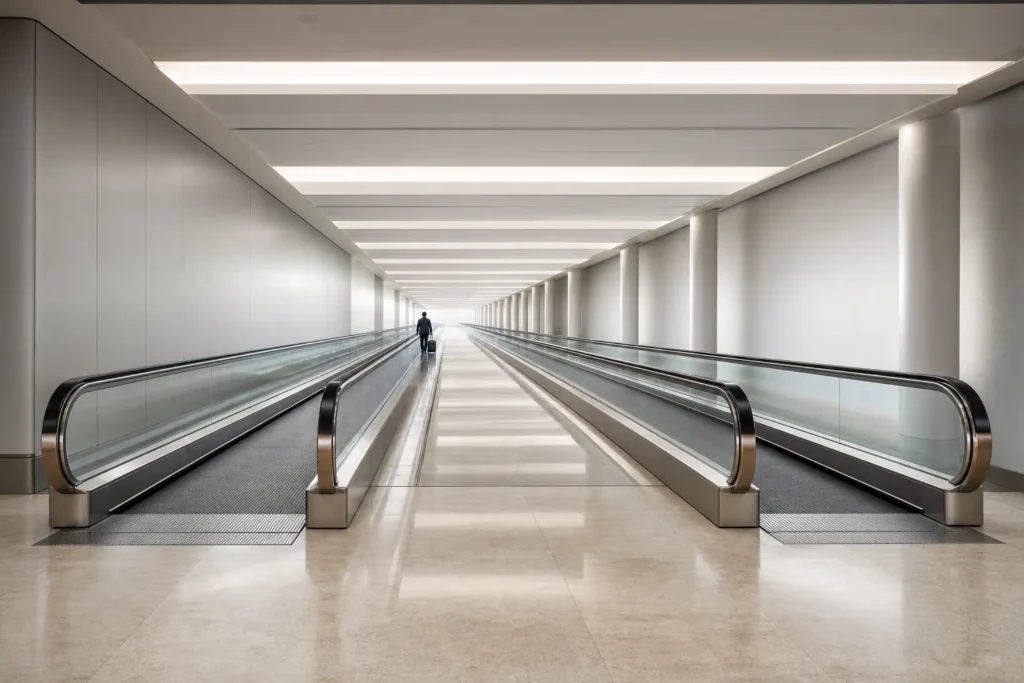
An escalator moves people between levels on linked steps, at a fixed inclination of 30° or 35°. A travelator — officially a moving walk — moves people along a flat or gently sloping surface, from 0° to 12°. One changes your height. The other changes your distance.
| Escalator | Travelator (moving walk) | |
|---|---|---|
| Term used in EN 115-1 and ASME A17.1 | Escalator | Moving walk |
| Carrying surface | Linked metal steps | Flat pallets, or a belt |
| Inclination | 30° or 35° | 0°, 10°, 11° or 12° |
| Job it does | Change level | Cover distance, with or without a slight change of level |
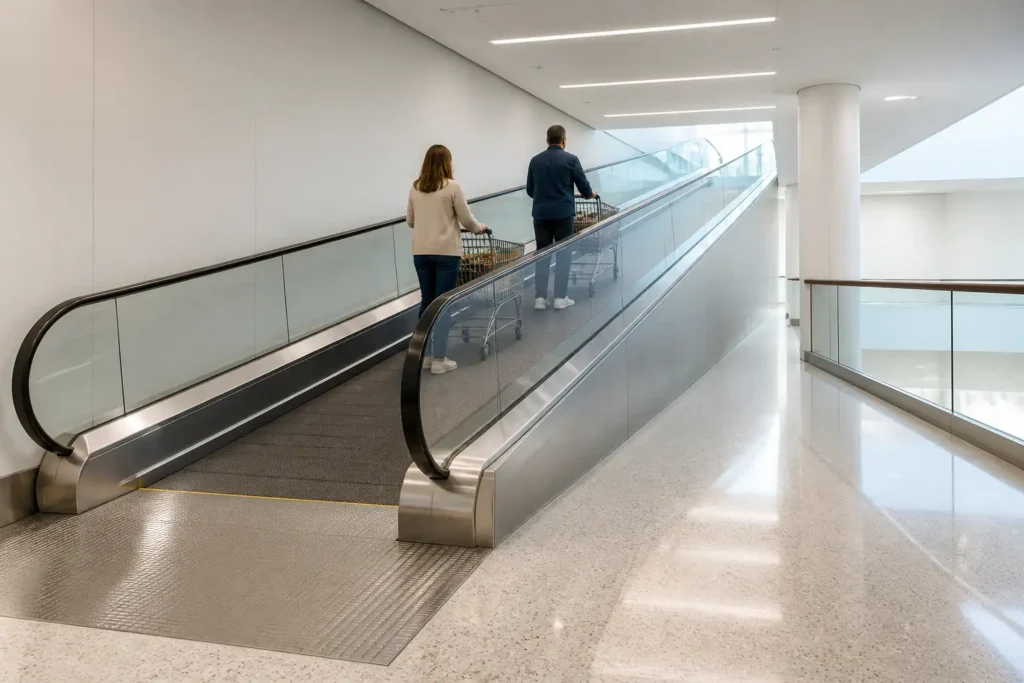
| Loads it accepts | People only | People, shopping trolleys, luggage carts, wheelchairs, strollers |
| Typical length | Short, fixed by the rise | Up to 200 m on a horizontal run |
Read the table as the short answer to moving walkway vs escalator questions, and as the difference between escalator and moving walk stated as parameters rather than opinions. That is the whole difference in six lines. Everything else that matters — speed, capacity, cost, maintenance, structural demand — follows from the inclination.
What a Travelator Really Is (and What It Is Not)
So what is a travelator, exactly, and why does the name cause so much trouble? The machine is standardised; the word is not. The travelator meaning is fixed — it is a moving walk, and that is the name to use in a specification.
The standard name is “moving walk”
EN 115-1:2017, Safety of escalators and moving walks — Part 1: Construction and installation, is the European standard that covers both products, pallet type or belt type. In North America the equivalent document, ASME A17.1 / CSA B44, also uses moving walk. So in a specification, in a quotation and on a drawing, the correct term is moving walk. “Travelator” is a market word that has never been the technical one.
There are two ways to build one:
- Pallet type. A continuous series of die-cast aluminium pallets linked into a loop. Pallet width between the walkway sides is commonly 800–1200 mm, and this type is structurally the closest cousin of an escalator: same truss, same balustrade, same handrail drive, comb plates at both ends.
- Belt type. A mesh metal or rubber belt running over rollers. Cheaper, and common on short flat runs.
If you compare a travelator vs moving walkway, note that both names describe this same machine. The difference is only in which market you are standing in. One useful distinction does exist inside the family: a horizontal walkway is level, an inclined moving walkway rises at 10°, 11° or 12°, and the two are designed for different jobs.
Where the word “travelator” comes from
The Oxford English Dictionary records travelator in print from 1955. In 1961, Dunlop demonstrated a flat moving walkway called the “Travelator” at Charing Cross Underground station in London, for a BBC exhibition, and the name took hold in British English and then across Commonwealth markets. That is why the word feels normal in the UK, India, Africa and Australia, and unfamiliar in the United States.
Regional and spelling variants all mean the same machine:
- travelator, travellator, travolator, trav-o-lator
- moving walkway, moving walk, moving sidewalk, moving pavement
- autowalk, movator, walkalator
A tender document that says travelator in one clause and moving walk in another is describing one machine, not two. If the drawings show two different runs, that is a different problem, and worth raising before pricing.
Is a travelator a horizontal escalator? No
“Horizontal escalator” is a search phrase, not an equipment name. An escalator is defined by its steps and its fixed 30° or 35° inclination; take the inclination away and you no longer have an escalator, you have a moving walk. Every search for horizontal escalator is really a search for a travelator. A supplier who quotes you a “horizontal escalator” is either using loose language or has not read the enquiry properly — either way, ask for the general arrangement drawing before you go further.
If you have wondered what is a horizontal escalator called in a specification, the answer is moving walk, and the machine you want is a travelator.
What an Escalator Really Is
Step design and the two standard angles
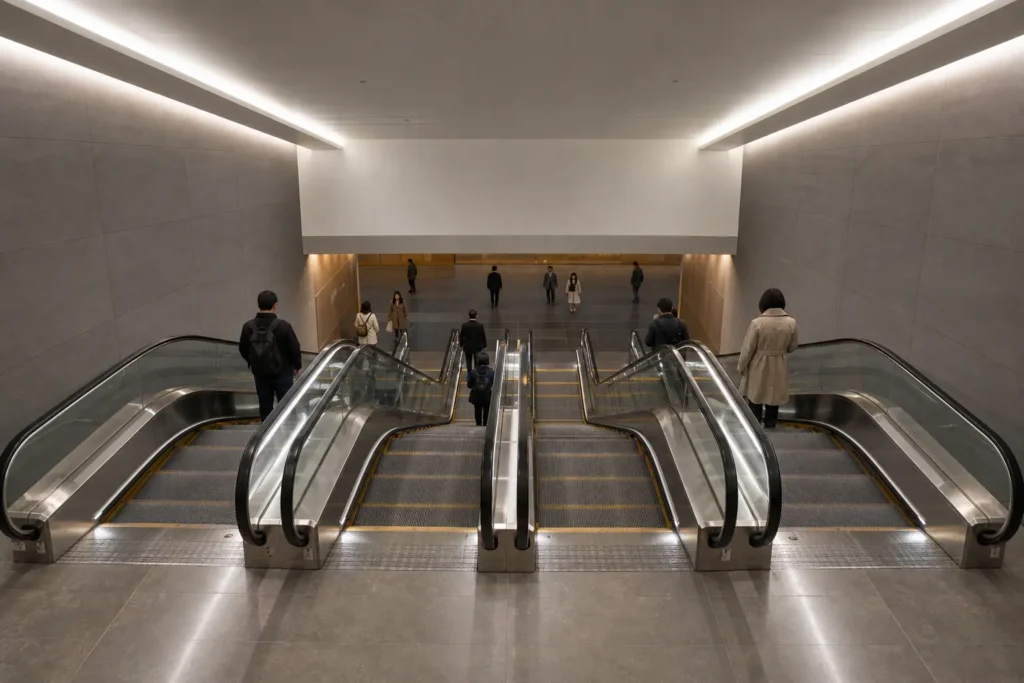
An escalator is a motorised, chain-driven step belt. Two pairs of chains run inside a truss, the steps are held horizontal through the travel by a step chain and cam mechanism, the handrails are driven at the same speed as the steps, and the steps disappear into an escalator comb plate at each landing. The escalator inclination angle comes in exactly two values: 30° and 35°. The escalator step width comes in three standard sizes: 600 mm, 800 mm and 1000 mm.
Why the 35° version costs you something
The steeper angle saves horizontal space. For the same rise, a 35° escalator needs about 17% less horizontal run than a 30° machine. But 35° is the less comfortable ride, so standards hold it back: the 35° unit is restricted to a lower nominal speed, 0.5 m/s, and a maximum rise of roughly 6 m. Above that rise, you buy a 30° escalator.
This is the point where the escalator vs stairs comparison becomes relevant. An escalator at 30° is comfortable enough for almost any passenger; at 35° it starts to feel steep, which is why you see 35° used for short, cheap rises and 30° used on public transport where the ride matters. The escalator 30 vs 35 degree decision is therefore a straight trade between floor space and passenger comfort.
The Full Comparison: Travelator vs Escalator
Most articles stop at a table of adjectives. Here is the same comparison with the parameters a consultant actually sizes against — rise, run, moving walkway dimensions, moving walkway width options, capacity and code limits.
| Parameter | Escalator | Travelator (moving walk) |
|---|---|---|
| Inclination | 30° or 35° | 0°, 10°, 11° or 12° — 12° is the ceiling |
| Carrying width | Step width 600 / 800 / 1000 mm | Pallet width 800 / 1000 / 1200 / 1400 / 1600 mm |
| Nominal speed | 0.50 / 0.65 / 0.75 m/s | 0.50 / 0.65 m/s |
| Rise ceiling | 35° limited to about 6 m; 30° units are built well above 20 m for metro stations | Inclined walks: about 5–6 m in practice |
| Run length | Fixed by the rise | 0° units: 200 m at 800 mm pallet width, falling to 115 m at 1600 mm |
| Theoretical capacity at 0.5 m/s | 4,500 / 6,750 / 9,000 persons per hour | 6,750 / 9,000 / 11,250 / 13,500 / 15,750 persons per hour |
| Realistic planning capacity | About 60–70% of theoretical | About 60–70% of theoretical |
| Trolleys, luggage carts, wheelchairs | Not permitted | Designed for them |
| Horizontal run for 5 m of rise | 8.7 m at 30°, 7.1 m at 35° | 23.5 m at 12°, 28.4 m at 10° |
| Main standards | EN 115-1 (new), EN 115-2 (existing), ASME A17.1 / CSA B44 | The same |
| Structural demand | Vertical opening, truss support at both landings, machine space | Long continuous opening, intermediate supports, long truss delivery |
| Energy modes available | Star-delta, two-speed, variable frequency, stop-and-go | The same |
The horizontal run is what actually decides the choice
The geometry is simple, and it explains most real projects:
Horizontal run = rise ÷ tan(inclination)
| Inclination | Multiplier | Run for 3 m rise | Run for 5 m rise | Run for 6 m rise |
|---|---|---|---|---|
| 35° | 1.43 × | 4.3 m | 7.1 m | 8.6 m |
| 30° | 1.73 × | 5.2 m | 8.7 m | 10.4 m |
| 12° | 4.70 × | 14.1 m | 23.5 m | 28.2 m |
| 10° | 5.67 × | 17.0 m | 28.4 m | 34.0 m |
For the same 5 m rise, a 12° travelator needs 2.7 times the horizontal run of a 30° escalator. That single ratio is the difference between a travelator and an escalator in most projects that fail.
Two conclusions follow, and they are the ones worth remembering:
- A travelator is not “a gentler escalator”. It is a machine that trades horizontal space for comfort, and buys the ability to carry wheeled loads. If the horizontal space is not there, no amount of preference for the travelator makes it fit.
- An inclined travelator cannot be used as a substitute for an escalator above about 5–6 m of rise. It is not a preference question — it is a limit of the product.
Capacity: the number on the datasheet is not the number you get
The theoretical capacity of escalator equipment and of moving walks uses the same relationship:
C = 3600 × v × k ÷ 0.4
Where C is theoretical capacity in persons per hour, v is nominal speed in metres per second, 0.4 is the 400 mm step or pallet pitch, and k is the number of passengers assumed side by side across the width.
| Carrying width | k | Escalator at 0.5 m/s | Moving walk at 0.5 m/s |
|---|---|---|---|
| 600 mm | 1.0 | 4,500 persons/h | — |
| 800 mm | 1.5 | 6,750 persons/h | 6,750 persons/h |
| 1000 mm | 2.0 | 9,000 persons/h | 9,000 persons/h |
| 1200 mm | 2.5 | — | 11,250 persons/h |
| 1400 mm | 3.0 | — | 13,500 persons/h |
| 1600 mm | 3.5 | — | 15,750 persons/h |
At 0.65 m/s, multiply these figures by 1.3. A 1400 mm walkway then reaches 17,550 persons per hour.
Three warnings before you put any of these numbers into a design.
First, this is a geometric figure, and no installation achieves it. The formula assumes every step or pallet is fully occupied from the moment you start counting. Planning references commonly quote around 6,000 persons per hour for a 1000 mm escalator at 0.5 m/s, against the 9,000 the formula produces. If the escalator capacity per hour or the moving walkway capacity per hour figure in a quotation is not qualified as theoretical or practical, ask which one it is and what occupancy assumption was used.
Second, a wider machine does not move proportionally more people. Passengers leave gaps. Two people will not stand shoulder to shoulder on a 1000 mm step unless they choose to, and they often do not. The step from 800 mm to 1000 mm does add capacity — but less than the table suggests, and in stations with luggage the gap widens further.
Third, calculate directions separately, and design against the critical period. An escalator bank with enough total capacity can still fail when 70% of the traffic moves one way in a ten-minute window. For a metro or an airport, the design period is not the hour — it is one train arrival or one flight wave. This is the single most common error in metro station escalator capacity studies.
Any escalator capacity calculation should state which capacity definition it used, and any moving walkway speed figure should be quoted together with the width it applies to, because the two produce the number between them.
Speed limits and what the codes allow
EN 115-1 permits nominal speeds of 0.50, 0.65 and 0.75 m/s; the 0.75 m/s setting applies to units up to 30° inclination. Moving walks normally run at 0.50 m/s, with 0.65 m/s used on long airport corridors where the extra time saving justifies it. Nothing in a standard product runs at 1.5 m/s.
For moving walkway inclination, EN 115-1 allows 0°, 10°, 11° and 12°, with 12° as the maximum. Above 6°, a cleated pallet surface is required so that passengers do not slip — this is why an inclined walkway looks different from a flat one underfoot. The ASME A17.1 moving walk section adds a clause that catches many projects out: if the pallet width exceeds 1000 mm (40 in), the maximum permitted inclination is 4°, and only a horizontal walkway may go out to 1600 mm (64 in). That clause alone explains why wide, inclined, high-capacity walkways do not exist on the market.

What each machine can carry
This is usually the deciding factor in retail.
| Load | Escalator | Travelator |
|---|---|---|
| Standing or walking passengers | Yes | Yes |
| Shopping trolley | No | Yes |
| Luggage cart, airport trolley | No | Yes |
| Wheelchair or mobility scooter | No | Yes, with supervision |
| Stroller, pram | Not intended | Yes |
| Flat-bed trolley, hospital trolley | No | Yes |
An escalator is not built for a wheeled trolley. The step edge, the comb plate and the skirt gap are all wrong for it, and staff routinely redirect trolley users to a lift. In a supermarket or hypermarket, that single point decides the purchase: a store with trolley traffic that installs escalators has to add a dedicated trolley lift, while a travelator does both jobs in one machine.
Where the question is travelator vs conveyor belt, the answer is just as practical. A conveyor belt moves goods on a flat surface with no handrails, no comb plates and no passenger safety chain. A travelator is a passenger-rated machine: handrails, balustrades, skirt brushes, comb plates, emergency stops, brakes and anti-reversal devices are all part of the product. You cannot substitute one for the other.
Safety and duty cycle
Escalator risks are well documented: falls on the step band, entrapment between step and skirt, incidents at the handrail entry and at the landings. The escalator safety requirements that address them are mandatory on new equipment: skirt brushes and deflectors, step demarcation lighting, comb plates, an anti-reversal device, an overspeed governor, step-chain break detection and emergency stops at both landings. Moving walkway safety features overlap heavily — handrails, balustrades, comb plates, emergency stops, speed monitoring — with the addition of pallet run guards and, on inclined units, cleated pallets.
EN 115-2 is worth knowing about even if you are not buying new equipment. It sets out rules for improving the safety of existing escalators and moving walks, and it matters when you are buying used equipment, taking over an older building, or planning a modernisation rather than a replacement.
Duty cycle should be specified, not assumed. A metro escalator may run 20–24 hours a day, semi-outdoor or fully outdoor. A shopping mall unit typically runs 12–14 hours. Office, hotel and hospital units run 10–12 hours. Airport walkways usually run 18–20 hours. Outdoor and semi-outdoor locations change the corrosion specification, the IP rating of the control system and the finish — and they change the price.
When to Choose a Travelator, and When an Escalator Is Better
The question of when to use a moving walkway and when to use an escalator is answered by the building, not by preference. Where a project compares travelator vs escalator vs elevator, note that the elevator is not in the same category: it is a vertical, on-demand machine for accessibility and short hops, and it does not solve a distance problem. The travelator vs stairs comparison is easier still — stairs cost nothing and are always available, but nobody pushes a loaded trolley up them.
Airports and transit hubs
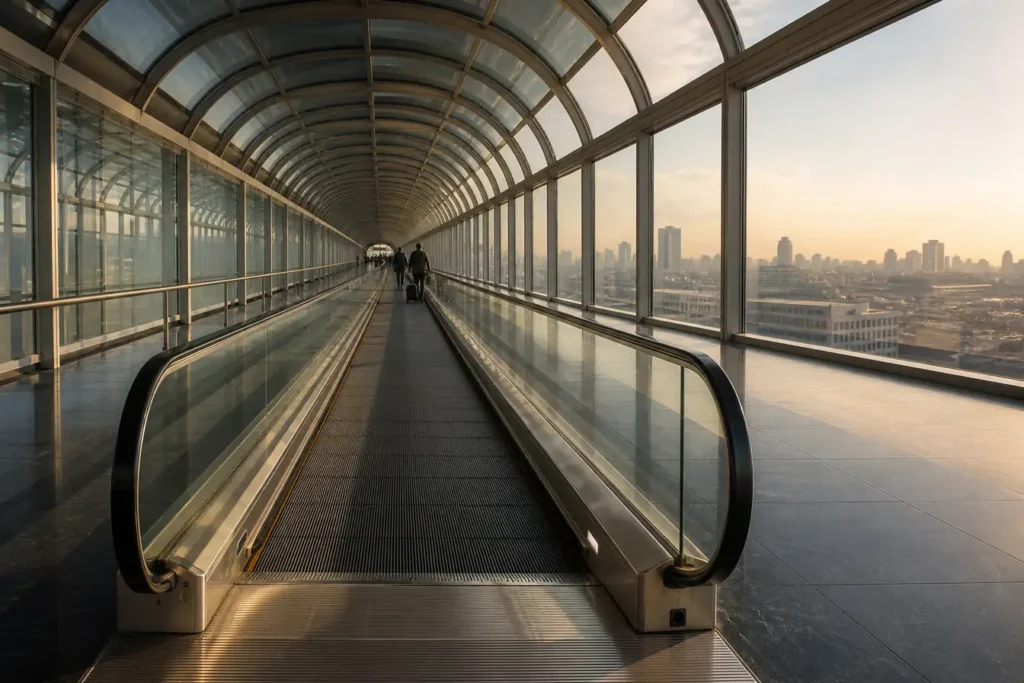
The problem in a terminal is distance, not height. Passengers with wheeled luggage walk long distances between check-in, security, piers and gates, all on one level. This is the classic case for an airport moving walkway. A typical moving walkway for airports is installed in pairs for opposite directions, with 0.65 m/s used on the longest corridors. A travelator for airport terminals earns its place because the traveller walks at roughly 1.2 m/s on a plain floor and around 2 m/s on a moving walk, so the same passenger arrives sooner and less tired. Where the distances run into several hundred metres, the layout starts to behave more like a people mover for airport terminal circulation than like a simple corridor, and it has to be planned as infrastructure.
Where a terminal does change level — between pier floors, or down to a station — an escalator appears. Well-run projects combine the two: a travelator for the flat run and an escalator or lift where the level changes, rather than forcing one machine to do both jobs.
Shopping malls, supermarkets and hypermarkets
The trolley rule comes first. Wherever customers move trolleys, a travelator for shopping mall circulation is the correct machine, and this has effectively become a retail design principle rather than a preference. It also keeps the customer inside the building: the trip from the car park, through the store and back with a full trolley never leaves a moving surface. The supermarket moving walkway is the clearest example of the rule in practice.
Escalators remain the better answer for pure footfall between shopping levels — they are cheaper per metre of rise and take far less horizontal space in an atrium. That is why the escalator for shopping mall atriums is still specified for footfall, while the travelator for shopping mall car park levels is specified for trolleys. Large malls use both.
One planning constraint applies to both: keep uninterrupted walking distances inside commercial buildings short. Long corridors push customers out. The accepted aim is to keep distances across commercial floors under roughly 50 m — which is also the threshold at which a moving walkway for shopping mall circulation starts to pay for itself.
Metros, rail stations and stadiums
This is mostly escalator territory. Crowds arrive in waves of several hundred people, and the design must follow the wave, not the average hour. For heavy-duty public transport: 1000 mm step width, 0.5 m/s, and a standby or reduced-speed mode for the hours with no traffic. Plan the maintenance window before you plan the bank — an escalator out of service removes a large share of the capacity, and redundancy earned through maintenance downtime is often worth more than the theoretical capacity of one more unit.
Where a station or stadium has a long transfer with a modest change of level, an inclined travelator does the whole job in one move, and avoids the queue that forms at the foot of an escalator.
Hospitals, care homes and accessibility
Wheelchairs, walking frames, mobility scooters and trolley-borne equipment do not work on an escalator, and an escalator is not an accessible route in any code. Where the question is travelator vs elevator, they are not competitors: the lift provides accessibility, the travelator provides distance. The same holds for escalator vs lift — an escalator is a capacity device, a lift is an accessibility device, and a compliant public building usually needs both. A long, flat or gently sloping public route inside a hospital or a care facility is exactly where a travelator removes the need for people to walk 200 m with a frame, while a lift that is sized for beds still handles the vertical journeys.
The usual arrangement for a hospital or a large care building is therefore: lifts for genuine accessibility, travelators for distance, and escalators only where visitor traffic is heavy enough to justify them.
The high-speed travelator lesson
Every serious attempt at an accelerating walkway has ended the same way.
- Dunlop Speedaway, developed from Battelle research in the 1970s, with an entry zone up to four people wide accelerating to a fast narrow lane: never put into commercial production.
- TRAX in Paris in the 1980s, with entry at 3 km/h and a maximum of 15 km/h: a technical failure, never exploited.
- CNIM trottoir roulant rapide at Montparnasse–Bienvenüe, 185 m long, opened in 2002 at 12 km/h and reduced to 9 km/h after safety concerns, then removed in 2011 after nine years of passengers losing their balance.
- ThyssenKrupp Express Walkway at Toronto Pearson, installed in 2007, decommissioned in 2020.
The failure reasons were consistent: passengers lost their balance at the acceleration and deceleration zones, riders carrying bags could not use the fast section and had to be filtered out by staff, and reliability was poor. If someone offers you an accelerating walkway as a capacity or cost solution, ask for the list of comparable installations still in service. A conventional walkway at 0.5–0.65 m/s does the job with a fraction of the risk.
What Drives the Cost of Each
Purchase price
If your first question is how much does a travelator cost, the honest answer is that no single figure means much without the specification. The escalator cost per unit is easier to bracket, because the product is more standardised.
Public listings from Chinese suppliers put commercial escalators in a band of roughly US8,500–20,000perunit∗∗,withmostmid−specification30°and35°unitsbetweenabout∗∗US8,500–20,000perunit∗∗,withmostmid−specification30°and35°unitsbetweenabout∗∗US9,000 and US13,000∗∗,andmovingwalksfromroughly∗∗US13,000∗∗,andmovingwalksfromroughly∗∗US9,000 to US$12,000 per unit. Treat those as starting points, not quotations, because inside a product line the escalator price and the travelator price move with a long list of variables:
- rise or run length
- step width or pallet width
- inclination
- indoor, semi-outdoor or fully outdoor rating
- balustrade type and height, glass or metal
- handrail material, cladding, lighting options
- control system and energy-saving mode
- certification and witness testing required by the destination market
A 6 m rise unit with 1000 mm steps, glass balustrades and outdoor rating can cost several times a basic 3 m indoor unit of the same family. For a moving walkway price per meter, the same logic applies in reverse: the price per metre falls as the run gets longer, because the drive, controls and landings are largely fixed. Ask for a price per metre at 30 m, 60 m and 100 m if you are comparing suppliers — a single figure is not comparable across different lengths.
For context on the market: the global escalator market was about US10.44billionin2025∗∗andisprojectedtoreachabout∗∗US10.44billionin2025∗∗andisprojectedtoreachabout∗∗US17.69 billion by 2031, roughly 9.2% annual growth, driven by urban transit and commercial construction.
If you would like to know the cost of purchasing an escalator or an autowalk, please contact LJ Elevator. We will provide you with a tailored product solution along with a detailed price list.
Installation and structural cost — where travelators lose
The machine price for a travelator is often close to an escalator of the same width. The building cost is where they separate. A travelator needs:
- a long continuous opening with no columns in the run
- intermediate supports along the truss, not only at two landings
- a delivery and lifting route for truss sections that can exceed 20 m in one piece
- fire, smoke and sprinkler coordination along the whole opening
- longer transition zones at both ends on inclined units than on an escalator
Remember the ratio from the geometry section: for the same 5 m of vertical travel, the travelator’s horizontal demand is 2.7 times the escalator’s. In a new building on a clean site that is a design decision. In an existing building it is usually where the option dies.
Running cost, energy and maintenance
Modern drives can cut energy use, and each option reaches a different maximum saving depending on passenger volume:
| Energy mode | Maximum saving potential |
|---|---|
| Star-delta (star drive at low load) | About 30% |
| Two-speed (idle speed at no load) | About 50% |
| Variable frequency drive | About 60% |
| Stop-and-go (unit stops when idle, restarts on a light barrier) | Up to 100% of the no-load loss |
Energy saving escalator standby mode and stop-and-go are the cheapest wins in a mall or an office building, where traffic is genuinely intermittent. In a metro station running 22 hours a day with short quiet windows, the return is smaller. A regenerative drive escalator recovers energy when the unit runs heavily loaded downhill; it is worth costing on a 20 m rise transit escalator and much less so on a flat walkway.
Escalator maintenance cost and moving walkway maintenance cost land in a similar range per visit, but the work is different in content. On an escalator: step chain, step rollers, comb plates, step demarcation lighting, handrail drive, brakes. On a travelator: pallet chain, pallet gap and comb engagement, pallet surface wear, handrail entry, drive and tensioning. In many jurisdictions a moving walk sits under exactly the same inspection and annual examination regime as an escalator. When people compare escalator vs moving walkway maintenance, the honest answer is that the labour rate per visit is similar and the parts profile is different — which matters more for a 20-year escalator running cost per year calculation than the purchase price does.
One practical point: on both machines, the modules that fail most often are the ones that are hardest to reach and cheapest to ignore — handrail drives, comb plates and step or pallet chains. A supplier who cannot give you a spare parts list with lead times for those items is a risk, whatever the price.
Common Mistakes and Myths
“A travelator is a short escalator.” It is not a length question, it is an inclination question. A 200 m travelator is normal; a 12 m inclined travelator at 12° is a ramp.
“Moving walks carry fewer people than escalators.” Width decides capacity, not the product family. A 1400 mm walkway at 0.5 m/s has a theoretical capacity of 13,500 persons per hour — higher than the 9,000 of a 1000 mm escalator at the same speed.
“Escalators run at 1.5 m/s.” EN 115-1 nominal speeds stop at 0.75 m/s, and even that is limited to units up to 30°. Anyone quoting 1.5 m/s is describing a high-speed walkway experiment, not a standard escalator.
“Design to the datasheet capacity.” Datasheet figures are geometric. Plan with 60–70% of them, then add a redundancy rule for maintenance downtime.
“Choose the steeper angle to save space.” 35° saves about 17% of the horizontal run and costs you speed and a rise ceiling of about 6 m. It is also the less comfortable ride, and in a shopping centre that becomes a visible complaint.
“A wide walkway can be as long as I need.” The wider the pallet, the shorter the permitted run. On a horizontal walkway, the maximum falls from 200 m at 800 mm to 115 m at 1600 mm.
“An inclined travelator can replace an escalator to reach upper floors.” Inclined moving walks top out at about 5–6 m of rise in practice, so above that an escalator or a lift is the only option.
“Travelators are the modern, safer choice, so specify them everywhere.” Inclined travelators at 10–12° carry their own hazard: passengers stand on a sloped flat surface with nothing to hold them in position, and trolleys can roll back if their brakes fail. Cleated pallets and correctly specified trolley brakes are not optional details on an inclined unit.
Specification Checklist: What to Send a Supplier
Give a supplier all twelve items below and you will get comparable quotations. Leave any of them out and you will be comparing prices for different machines.
| # | Item | Why it matters |
|---|---|---|
| 1 | Exact rise and run | Decides whether a 12° unit can reach at all |
| 2 | Intended use: people only, or trolleys, luggage and wheelchairs | Decides escalator vs travelator |
| 3 | Peak flow and directional split, up and down separately | Drives the capacity calculation |
| 4 | Critical design period: one train, one flight, event dismissal | The real design load |
| 5 | Step or pallet width from the calculation, not from habit | Width is the capacity driver |
| 6 | Inclination, and the horizontal projection it requires | The most common source of layout failure |
| 7 | Nominal speed, and whether the layout supports it | Speed costs horizontal transition space |
| 8 | Indoor, semi-outdoor or fully outdoor | Changes corrosion and IP specification |
| 9 | Daily operating hours and expected service life | Sets duty cycle and drive selection |
| 10 | Control and energy mode: stop-and-go, VFD, sleep mode, remote monitoring | Affects running cost and the price |
| 11 | Standards and certification to be met, with witness testing | EN 115-1, EN 115-2 for existing units, ASME A17.1 / CSA B44, plus local code |
| 12 | Structural and delivery conditions: truss weight, support points, lifting access, opening dimensions | The reason many projects change product |
With any quotation, ask for five documents: the capacity calculation with its stated assumptions, the general arrangement drawing with rise, run, pit and overhead dimensions, the standard compliance statement, the recommended maintenance interval and scope, and a reference list of comparable installations. A travelator manufacturer or a moving walkway supplier in China who can produce all five quickly is usually the one who has done the job before.
FAQ
Is a travelator the same as an escalator? No. An escalator carries you between levels on steps at 30° or 35°. A travelator — officially a moving walk — carries you along a flat or gently inclined surface between 0° and 12°. They share the same technology family: truss, balustrade, handrail, comb plates, and the same safety chain. They do different jobs.
What is the difference between a travelator and a moving walkway? None. They are two names for one machine. Moving walk is the term used in EN 115-1 and ASME A17.1, moving walkway is the common name in North America, and travelator is the common name in the UK and Commonwealth markets. Moving sidewalk, autowalk, movator, travolator and walkalator are further variants. Choose one term and use it consistently in your documents.
Is there such a thing as a horizontal escalator? Not as a product. It is a search phrase for a travelator. An escalator is defined by having steps at a fixed 30° or 35°, so it cannot be horizontal. Equipment that is level and carries people standing or walking is a moving walk. The reverse question — is a moving walkway an escalator — has the same answer: no.
Which is faster, a travelator or an escalator? As machines they are about the same: both normally run at 0.5 m/s, with 0.65 m/s used on long walkways and in some transit installations. What differs is what the passenger can add. On a flat travelator you add your own walking speed to the belt and can reach roughly 2 m/s — about four times the speed of standing still on it, and around two thirds faster than walking the same corridor on a plain floor. An escalator cannot help you cover distance — it only changes your level.
Can you take a shopping trolley on an escalator? No, and it should not be attempted. Escalator steps are shaped for feet, the comb plate and skirt gap are wrong for wheels, and a trolley on a step is unstable. Where trolleys have to change level, the correct machine is a travelator or a dedicated trolley lift.
Is a travelator safer than an escalator? Neither is inherently safer; the hazards are different. Escalators concentrate risk at the step band, the skirt gap and the landings. Inclined travelators add slipping on a sloped surface and trolleys rolling back. Both rely on the same protection: handrails, balustrades, comb plates, emergency stops, anti-reversal devices and speed monitoring, with EN 115-1 governing new equipment and EN 115-2 governing safety improvements on existing units.
What is the maximum inclination for a moving walk? 12° under EN 115-1, and above 6° the pallets must be cleated so that passengers do not slip. In North America, if the pallet width exceeds 1000 mm the maximum inclination drops to 4°, and only a horizontal walkway may go wider than that, up to 1600 mm.
Why do airports use travelators instead of escalators? Because the problem is distance, not height. Passengers with luggage walk long distances between check-in, security and gates on a level floor. A walkway lets them stand or walk and shortens that journey without requiring a level change. Escalators appear where the terminal genuinely changes level — between pier floors, or down to a station.
Can wheelchairs use escalators? No, and an escalator should never be treated as an accessible route — no code accepts it as one. A wheelchair, a mobility scooter or a passenger with a walking frame needs a lift, or a travelator on a long level route. This is one of the clearest dividing lines between the two machines: an escalator only carries people who can step onto it, while a travelator can be used by almost anyone who can stand unaided.
Conclusion
If you remember one line from this travelator vs escalator comparison, make it this: an escalator changes your level, a travelator changes your distance.
Three rules cover most projects:
- A level change of more than about 6 m, with foot traffic only, is escalator work.
- A flat run of any real length — or any run where trolleys, luggage carts and wheelchairs travel — is travelator work.
- A project that needs both is not a compromise. It is the normal, correct answer, with escalators and moving walks sharing the circulation.
Run the geometry first, then the capacity, then the codes, and the choice usually makes itself. If a supplier quotes you a product before asking for the rise, the run and the loads, they are guessing.
LJ Elevator supplies escalators and moving walks, horizontal and inclined, for airports, transit and retail projects, and issues the capacity calculation and general arrangement drawing with every quotation. Send the checklist in this article and we will come back with numbers rather than adjectives.