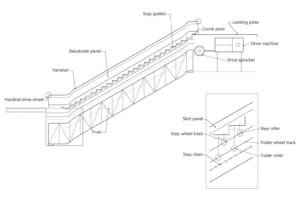
What is a traction elevator? Most people ride one every day and never see the part that does the work.
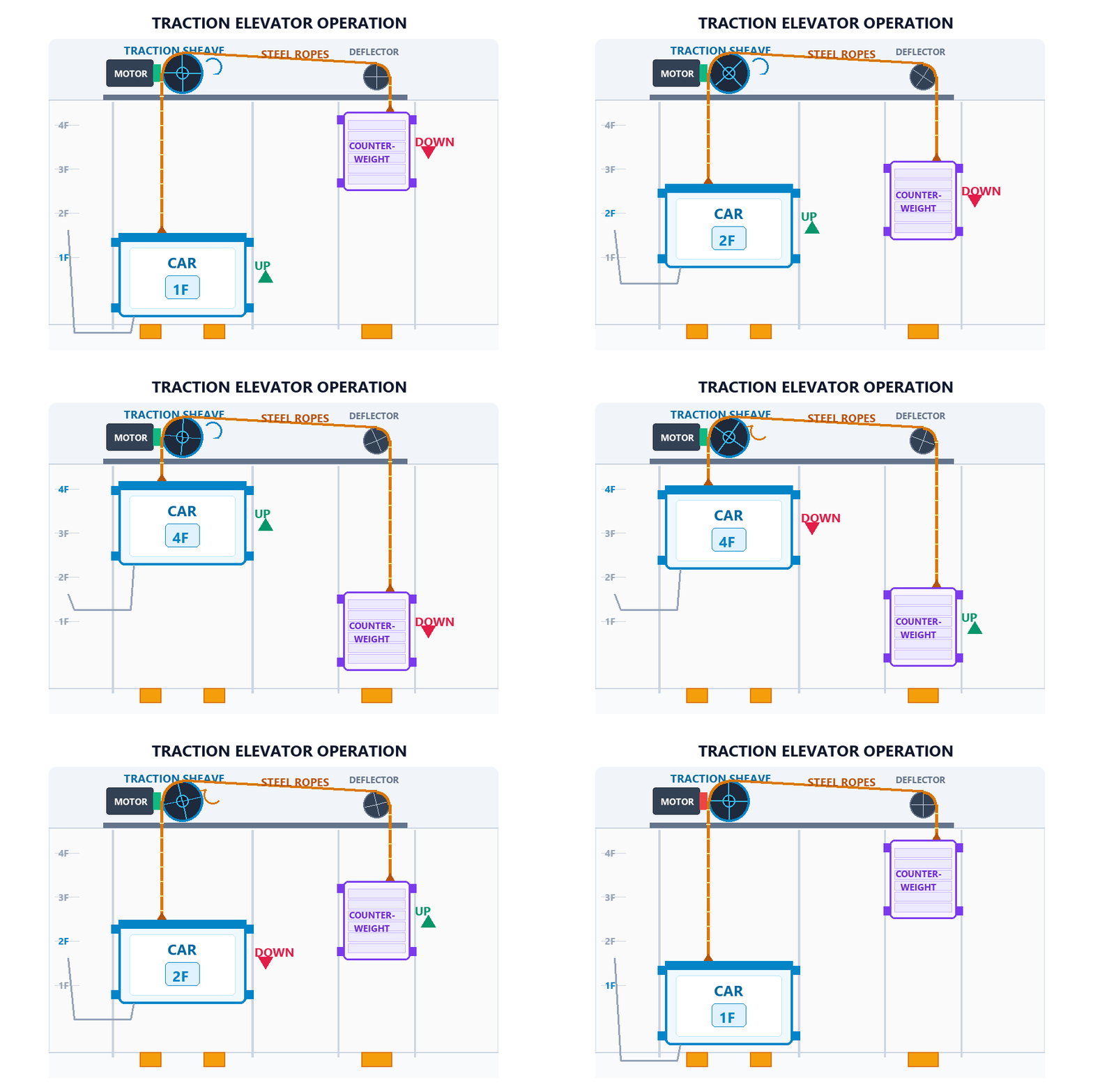
A traction elevator lifts the car with steel ropes that grip a motor-driven wheel. On the other side of that wheel hangs a counterweight. The two sides almost balance, so the motor only has to push the difference between them.
That is the whole idea. Everything else — the machine, the rails, the safety gear — exists to make that one idea work, safely, thousands of times a day.
The Short Answer
So what is a traction elevator, in one sentence? It is an elevator pulled up and let down by ropes running over a grooved wheel.
Three things make it work. Ropes or belts, not a hydraulic ram. A counterweight on the other end. A motor that turns the wheel.
An electric traction elevator is the standard kind: mains power, one motor, one brake. There is nothing exotic in it, and electric traction elevators are what most buildings use.
If your building has more than five or six floors, this is almost certainly the type inside it. A hydraulic lift serves low-rise buildings well, but it cannot follow a tall one up.
How Rope and Friction Lift a Car
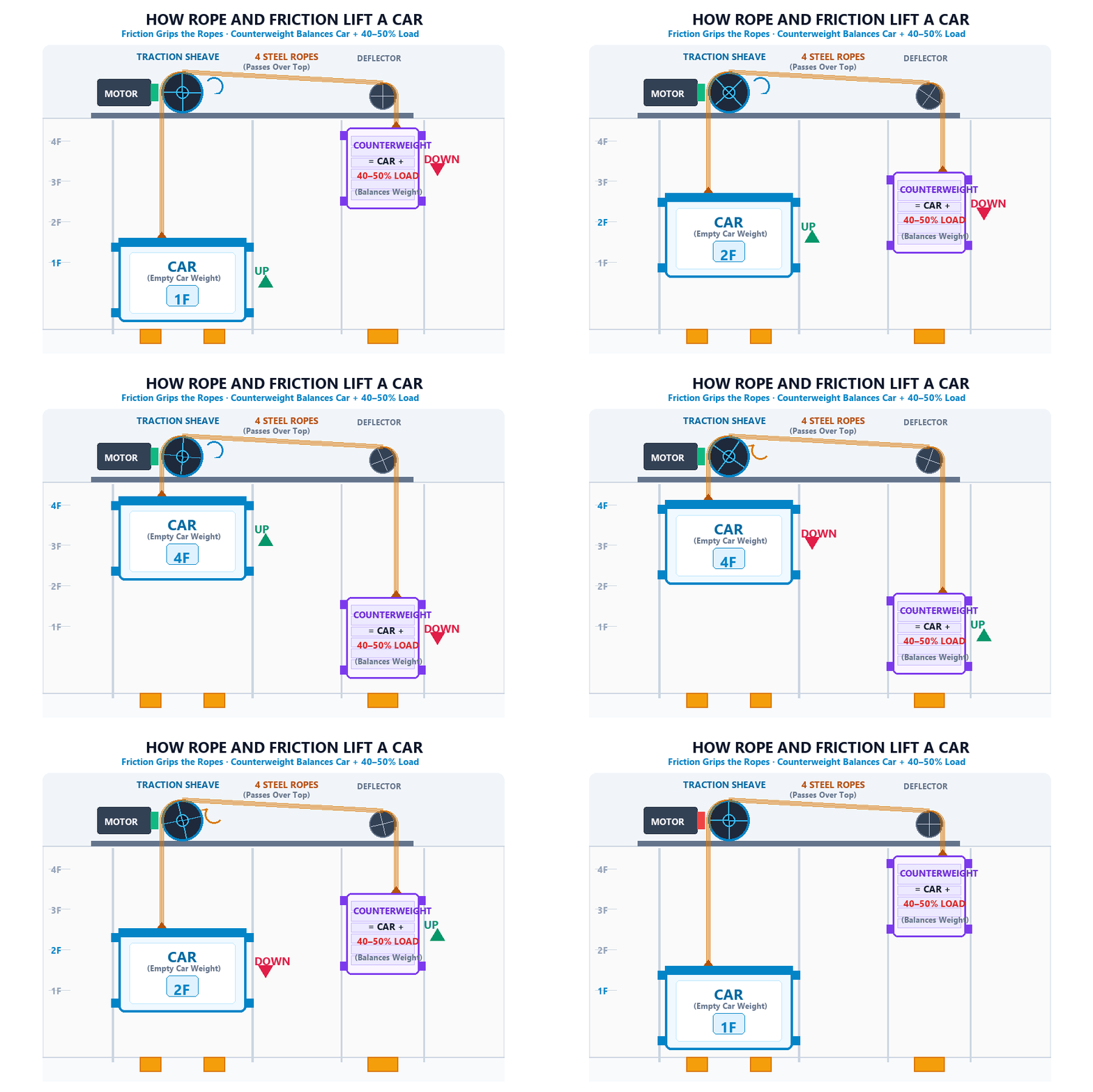
Start at the wheel. The traction sheave is a steel wheel with spiral grooves cut into its face. The rope sits in those grooves. Most elevator traction sheaves carry four to six of them; on newer machines a wide elevator traction belt does the same job in one piece. It is not wound around a drum like a winch — it passes over the top, held by friction and by the weight hanging on each side.
Now the counterweight. It weighs about the same as the car, plus 40 to 50 percent of the rated load. That is the trick of the whole machine. With both sides nearly equal, the motor only lifts the difference. A small motor moves a heavy car.
If a rope ever fails, a governor trips and safety gear clamps the car to the rails. That is why a rope lift is not a gamble. It is a system with two independent ways to stop, and the whole traction elevator system rests on that.
The Parts, From Top to Bottom
That is the full list of traction elevator components. Eight parts do the work:
- Traction machine — the motor and brake unit that turns the sheave.
- Traction sheave — the grooved wheel the ropes pass over.
- Ropes or belts — steel ropes, or flat steel belts on newer machines.
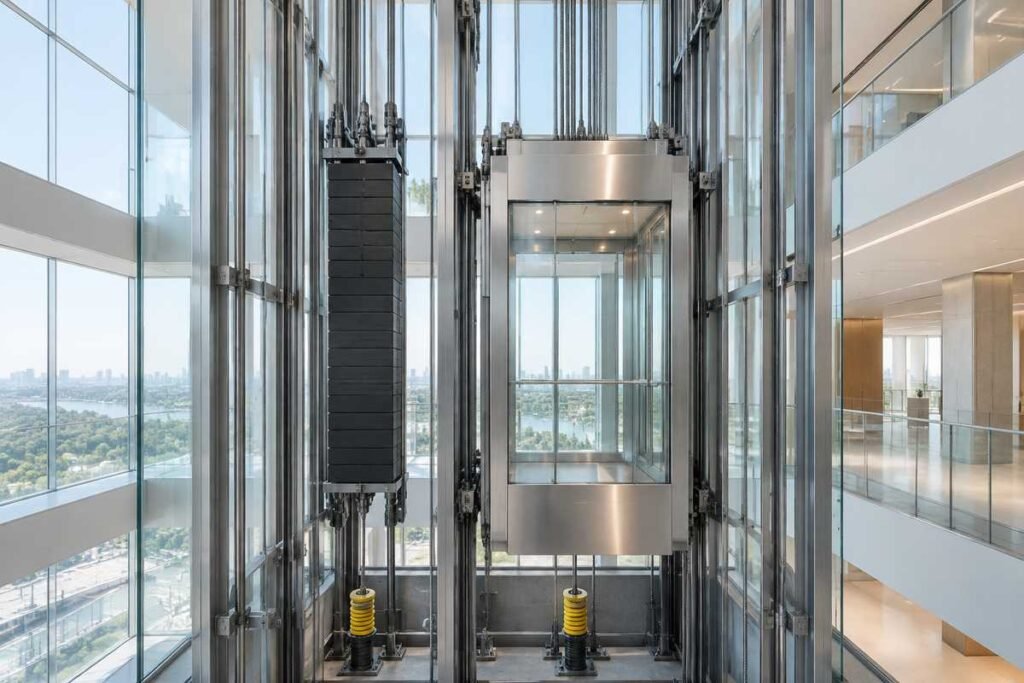
- Counterweight — stacked steel plates on the other end of the ropes.
- Guide rails — vertical steel rails. The car and the counterweight run between them.
- Governor — a speed-sensing device that trips the safety gear.
- Safety gear — wedges under the car that clamp the rails if it overspeeds.
- Controller — the cabinet that decides when to start, stop, and level.
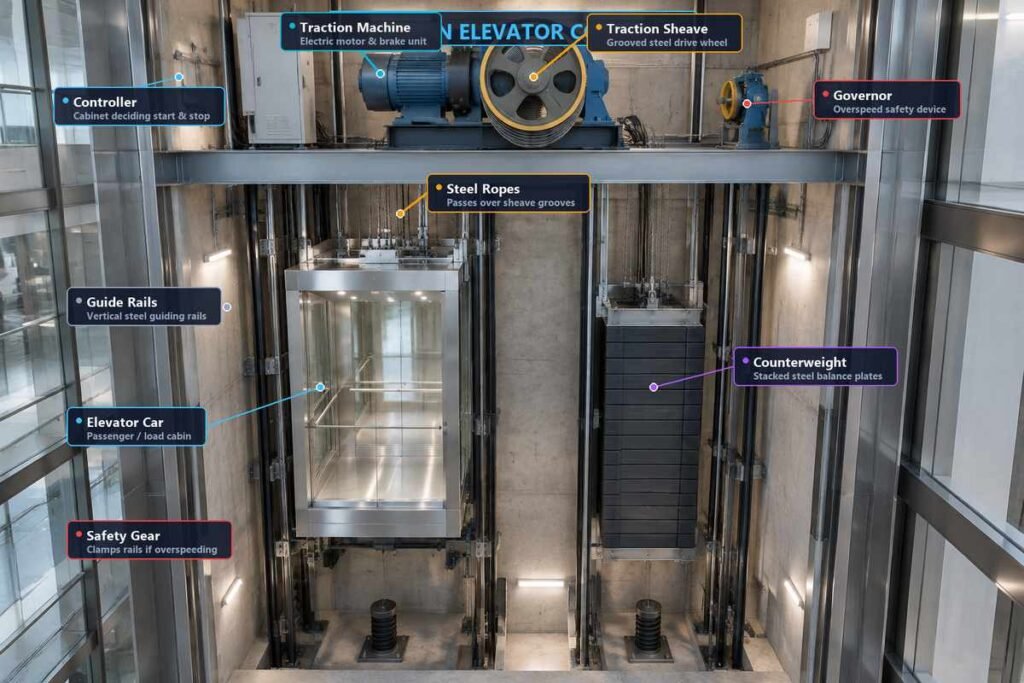
Most traction elevator diagram drawings show only the first four. The other four are what make those four safe to use. Nothing else in the package moves.
Where they sit: the machine and controller are in the machine room, or at the top of the hoistway on an MRL. The rails and counterweight are in the hoistway. The governor is usually at the top, with its rope running the full height of the shaft.
Geared or Gearless
The difference between geared and gearless traction elevators comes down to one part: the gearbox.
A geared traction elevator has one. The motor spins fast, and the gearbox slows it down while multiplying torque. Geared traction elevators are older, louder, and need more attention — oil in the gearbox, and wear in the worm gear. They are still common in buildings from the 1980s and 1990s, and spare parts are easy to find.
A gearless traction elevator has no gearbox. A gearless elevator traction machine is a permanent-magnet motor that turns the sheave directly, at low speed. The result is quieter, more efficient, and smaller. Almost every machine ordered new today is gearless, and both geared and gearless traction elevators are still supported by parts makers. The geared vs gearless traction elevator question is really a question about maintenance, not about lifting.
How to tell them apart without a manual: stand in the machine room and listen. A geared machine has a steady gear whine. A gearless one is close to silent, with a low hum. The same test works on an older Dover traction elevator or any machine of that era.
Where the Machine Sits
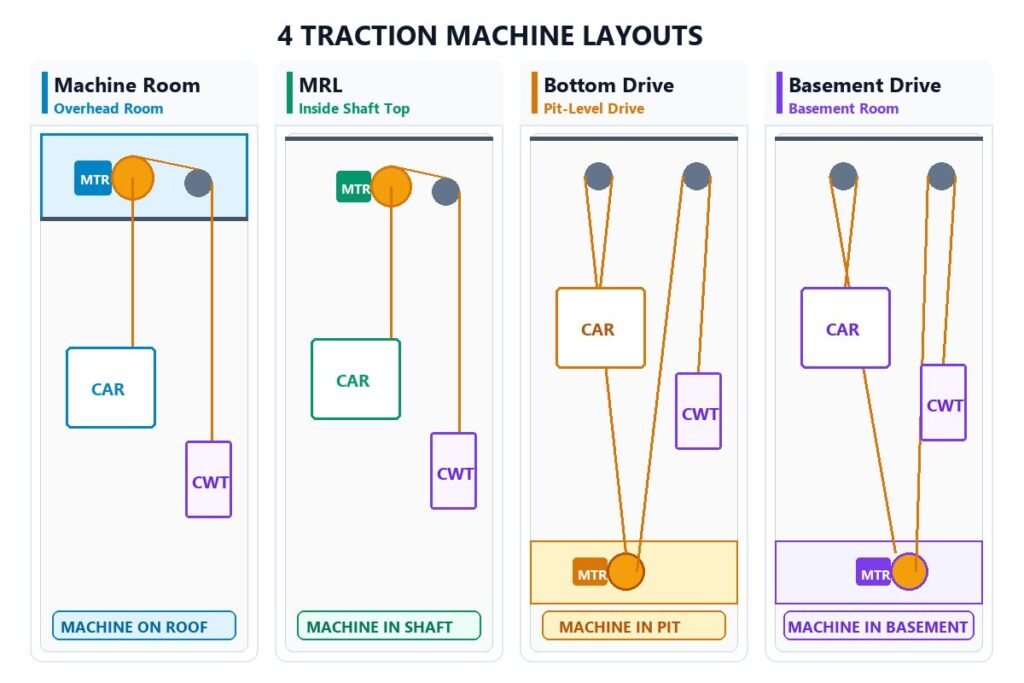
Four layouts, and the choice is mostly about space.
Machine room. The classic layout. A room above the shaft holds the machine. Easy to service, but it costs floor area and adds height.
MRL, machine room less. A machine room less traction elevator mounts on the guide rails or on a beam at the top of the hoistway. No separate room, but the top of the shaft must be tall enough to work in, and the heat has to go somewhere. That is what a machine-room-less traction elevator buys you: floor area.
Bottom drive. A bottom drive traction elevator sits at pit level and drives from below. This saves overhead height, which matters in old buildings with low roofs.
Overhead traction elevator and basement traction elevator layouts are variations on the same idea: an overhead traction elevator puts the machine above the shaft, a basement traction elevator puts it below.
Before you choose between a machine room traction elevator and an MRL, measure two things: the headroom above the top floor, and the pit depth below the bottom floor. Those two numbers decide more than any brochure.
Traction or Hydraulic
Two questions decide it: how high, and how often.
A hydraulic elevator pushes the car up with a ram and oil. It is simple, needs no counterweight, and is happy with two or three floors and light use. Past about 21 metres of travel it stops being practical, and it is slow — usually under 1 m/s.
A traction elevator has no such ceiling. It runs from about 0.5 m/s to well over 5 m/s, and it handles any height a building can offer. That is the short version of hydraulic elevators vs traction elevators, and of the older traction elevator vs hydraulic elevator argument. It explains why tall buildings almost never use hydraulics.
| Traction | Hydraulic | |
|---|---|---|
| Travel | Any height | Usually under 21 m |
| Speed | 0.5–10 m/s | 0.15–1.0 m/s |
| Energy | Lower — the counterweight carries most of the load | Higher — every trip lifts the full load |
| Noise | Quiet, near silent when gearless | Pump noise, low frequency |
| Machine space | Machine room or MRL | Machine room plus a power unit |
| Pit and headroom | Pit 1.2–1.8 m, headroom 3.2–3.8 m | Ram needs a pit or a borehole, headroom is low |
| Upfront cost | Higher | Lower |
| Running cost | Lower | Higher |
| Best for | Mid and high rise, frequent use | Low rise, low traffic, heavy loads |
If you have already searched hydraulic vs traction elevator, you have seen a hundred versions of this table. The honest addition most of them leave out is this one. Both hydraulic and traction elevators are mature machines. Neither is a compromise.
Traction is not always the right answer. A three-storey building, low traffic, a low roof, and a tight budget: a hydraulic lift may serve you better for twenty years. Choosing traction there is paying for capability you will never use. The difference between hydraulic and traction elevators is usually not the machine. It is the building. And the gearless traction elevator vs hydraulic choice at twenty metres of travel almost always goes to traction.
What It Costs, and What Moves the Number
Nobody can give a real traction elevator cost without a specification. Anyone who does is guessing.
What moves the number, in order of weight:
- Machine type. Gearless costs more than geared, and lasts longer.
- Travel and capacity. More floors and heavier loads mean a bigger machine.
- Doors. The door operator and the doors are a large share of any lift.
- Civil work. Pit, headroom, shaft size, and whether the building is ready.
- Volume. A traction elevator packages order — ten identical units — costs less per unit than one.
Ask for the elevator traction machine price and the rest broken into these five lines. That is also how to read a hydraulic vs traction elevator cost comparison fairly. A single figure hides where the money went.
In a House
A home lift is where the two types actually compete, because the numbers are small enough for both to fit.
A residential traction elevator wins when the house has three or more stops, the lift is used daily, and quiet matters. A gearless machine is small enough to sit in a closet-sized space.
Hydraulic wins when the house has two or three stops, the lift is used now and then, and the budget is tight. It needs a pit and a power unit, but the equipment costs less.
The hydraulic vs traction home elevator question is usually settled by headroom. A traction home elevator needs space above the top floor. If the roof is low, that decides the argument before anything else. The same is true of a hydraulic vs traction residential elevator comparison in a renovation: the existing shaft often chooses for you.
For Freight
A traction freight elevator is common in warehouses and factories with several floors. Heavy loads are fine — the machine is sized for them, and the counterweight takes the rest.
The exception is very heavy loads over one or two floors. There, a hydraulic freight lift is often cheaper to buy and easier to install, because it needs no counterweight and no tall machine space.
What to Ask Before You Order
Six questions, in this order:
- Geared or gearless? Ask for the model number, not the word.
- Rope or belt? Both work. Belts need different sheaves and different spares.
- Machine room or MRL? Then confirm the headroom the supplier needs.
- What is the counterweight? It should be near car weight plus half the load.
- What pit depth and headroom are on the drawing? Compare with what you have.
- Which standard is it built to? EN 81-20 and ASME A17.1 are the two you will meet most.
When you compare traction elevator manufacturers, or compare elevator traction machine manufacturers, ask all six of each one. The answers sort them faster than any catalogue. And if a supplier cannot answer question five, that tells you something too.
Questions People Ask
How are traction elevators primarily operated? How do traction elevators work in one line? An electric motor drives a sheave, with the car and the counterweight on opposite ends of the ropes. The motor only overcomes the difference in weight, which is why the machine looks small for the load.
Do traction elevators need a machine room? No. An MRL machine mounts on the guide rails or on a beam at the top of the hoistway. It still needs headroom and ventilation — just not a separate room. That is the whole of the mrl vs traction elevator debate: they are the same machine, in a different place.
Traction or hydraulic for a three-storey building? Either can work. Count the stops and the daily trips. A busy three-storey building is better served by traction. A quiet one is usually cheaper on hydraulic. This is the practical form of the difference between traction and hydraulic elevators.
How does a traction elevator work when the power fails? The brake is spring-applied and held open by power. When the supply drops, the brake sets and the car stops. Rescue then runs on the manual release or the emergency lowering device.
How long do the ropes last? It depends on load, sheave condition, and maintenance. Most ropes are replaced on inspection findings — broken wires, wear, or stretch — not on a fixed calendar.
Can an old hydraulic lift be converted to traction? Sometimes, but it is a rebuild, not a swap. New machine, often new rails, and a different pit and headroom requirement. That is what hydraulic traction elevator services usually come down to. Check the shaft dimensions first. If the headroom is short, the answer is usually no.
The Order That Saves Money
What is a traction elevator, after all this? A simple machine with a good idea inside it: balance the load, then move only what is left.
So measure the building before you choose the drive — height, headroom, pit, traffic. That order saves more money than any discount you will be offered.
LJ Elevator builds complete traction elevators, geared and gearless, with and without a machine room. If you are still at the measuring stage, send us the shaft drawing and we will tell you which machine fits it.