
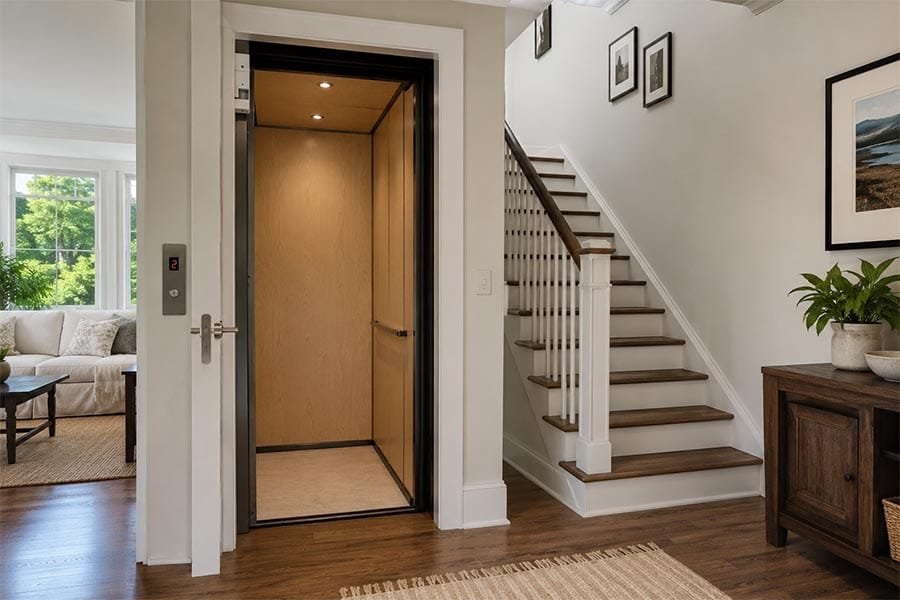
Choosing the right home elevator dimensions is one of the most important steps when planning a residential lift. Residential elevator dimensions affects not only passenger comfort but also the required shaft space, structural design, and installation cost.
In general, most residential elevator shaft dimensions between 1200 × 1200 mm (47 × 47 in) and 1800 × 1800 mm (71 × 71 in). The exact dimensions depend on the cabin size, load capacity, drive system, and whether the elevator needs to accommodate a wheelchair.
Many homeowners focus only on the cabin dimensions. In reality, the overall installation space includes the shaft, landing door, pit depth, overhead clearance, and mechanical components. Understanding these requirements in advance can help avoid costly modifications during construction or renovation.
Whether you are building a new house or upgrading an existing one, selecting the proper residential lift dimensions ensures a safer, more comfortable, and more efficient solution for your family.
In this guide, you will learn:
- Standard home elevator dimensions
- Minimum space required for installation
- Home elevator shaft dimensions
- Cabin size recommendations for different capacities
- Wheelchair-accessible elevator dimensions
- How to choose the best size for your home
- Small residential lift dimensions
- Home elevator installation prerequisites shaft dimensions requirements
By the end of this article, you will have a clear understanding of how much space a home elevator needs and how to select the right dimensions for your project.
What Are Standard Home Elevator Dimensions?
There is no single standard size for a home elevator. The dimensions vary depending on the number of passengers, load capacity, drive system, and available installation space.
For most residential projects, manufacturers offer several common sizes that meet the needs of different homes. Choosing the right home lift dimensions ensures comfortable use while making the best use of the available space.
The table below shows the typical dimensions of residential elevators.
| Capacity | Cabin Dimensions (W × D) | Shaft Dimensions (W × D) | Suitable For |
| 1 Person | 700 × 800 mm | 1000 × 1000 mm | Compact homes |
| 2 Persons | 800 × 1000 mm | 1200 × 1200 mm | Small families |
| 3 Persons | 900 × 1200 mm | 1400 × 1400 mm | Daily residential use |
| 4 Persons | 1000 × 1300 mm | 1500 × 1500 mm | Larger homes |
| Wheelchair Accessible | 1100 × 1400 mm | 1600 × 1600 mm or larger | Barrier-free access |
These dimensions are for reference only. The final size may vary depending on the elevator manufacturer and local building requirements.
Understanding the Different Dimensions
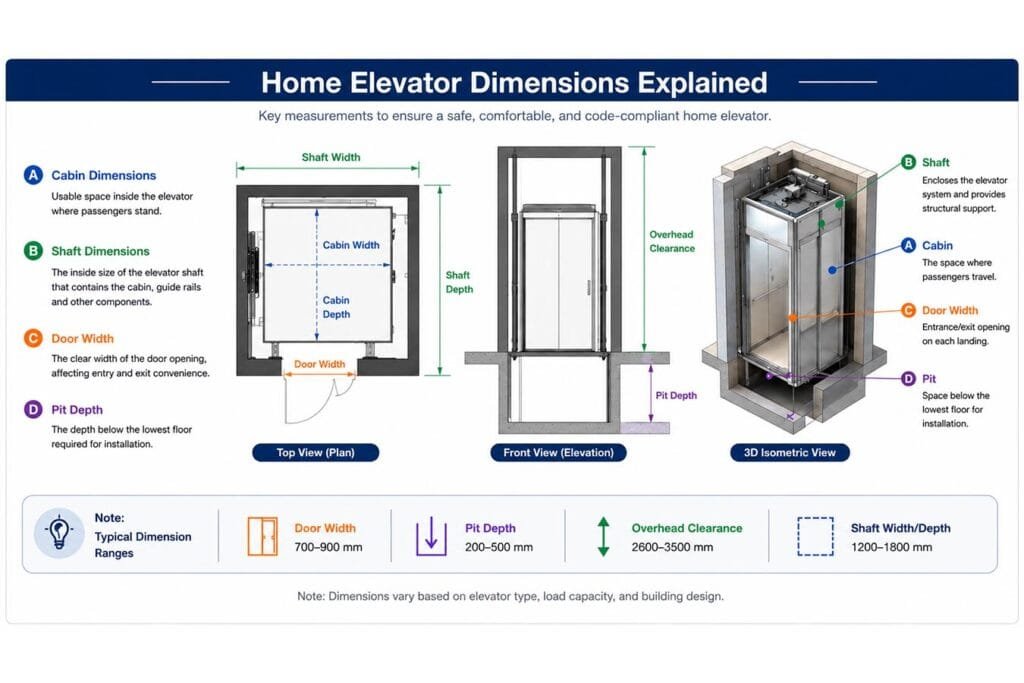
When planning a home elevator, it is important to understand that several different dimensions are involved.
Cabin Dimensions
Cabin dimensions refer to the usable space inside the elevator where passengers stand.
A larger cabin provides more comfort and allows space for wheelchairs, baby strollers, or heavy household items.
Residential elevator shaft size
The shaft dimensions describe the inside size of the elevator shaft that contains the cabin and guide rails.
The shaft must always be larger than the cabin because it also houses the operating components and safety systems.
Door Opening Width
The door width affects how easily people can enter and exit the elevator.
For standard residential elevators, the door opening is usually between 700 mm and 900 mm. A wider entrance is recommended for wheelchair users or when moving furniture.
Overall Installation Space
The total installation space includes more than just the shaft.
A complete home elevator project may also require:
- Pit depth below the lowest floor
- Overhead clearance above the top floor
- Landing entrance space
- Control and drive components
- Maintenance access
These factors should all be considered during the design stage.
Cabin Size vs. Shaft Size
One of the most common misunderstandings is assuming that the cabin size and shaft size are the same.
In reality, the shaft must provide enough room for the guide rails, safety devices, and structural clearances.
For example, a cabin measuring 900 × 1200 mm may require a shaft measuring approximately 1400 × 1400 mm.
Understanding this difference early can prevent costly redesigns during construction.
Which Dimensions of Home Elevator Is Best?
For most private homes, a cabin size of 900 × 1200 mm offers a good balance between comfort and space efficiency. It is suitable for everyday family use while fitting into many residential buildings.
If future accessibility is a concern, choosing a larger cabin from the beginning is often a smart investment. It provides greater flexibility and can better accommodate changing family needs over time.
What Is the Minimum Space Required for a Home Elevator?
One of the first questions homeowners ask is, “How much space do I need for a home elevator?”
The answer depends on the type of elevator, its load capacity, and the design of the building. Modern residential elevators are available in compact designs, making installation possible even in homes with limited space.
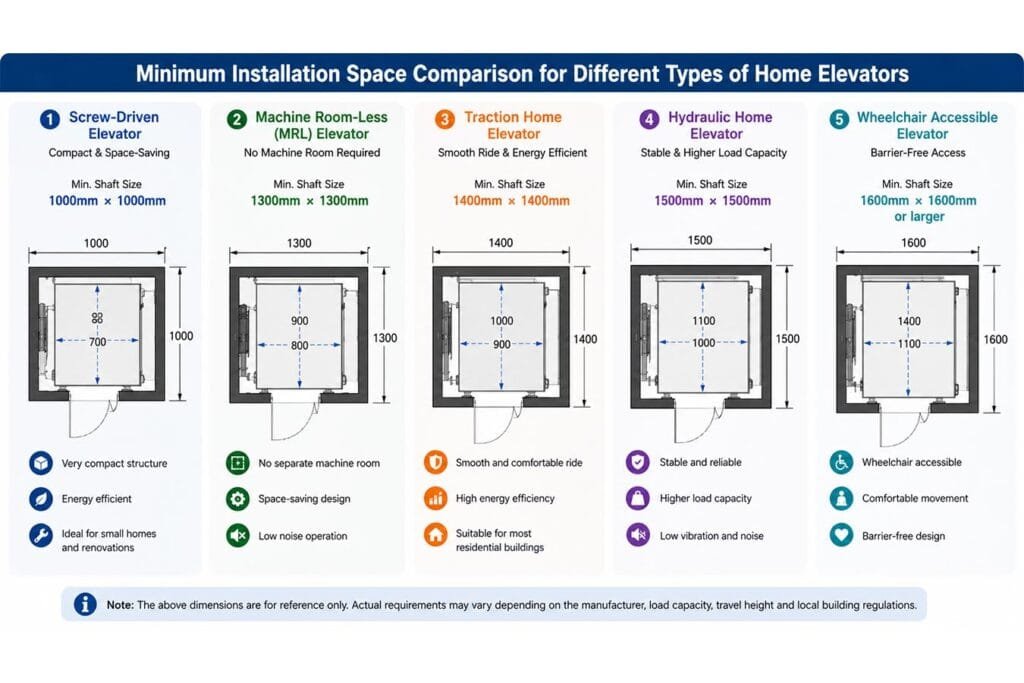
The table below shows the typical minimum installation space for different types of home elevators.
| Elevator Type | Typical Minimum Shaft Size | Features |
| Screw-Driven Elevator | 1000 × 1000 mm | Compact design with a small footprint |
| Machine Room-Less (MRL) Elevator | 1300 × 1300 mm | Saves space by eliminating a separate machine room |
| Traction Home Elevator | 1400 × 1400 mm | Smooth ride and energy efficient |
| Hydraulic Home Elevator | 1500 × 1500 mm | Stable operation with higher load capacity |
| Wheelchair Accessible Elevator | 1600 × 1600 mm or larger | Designed for barrier-free access |
These dimensions are general references. The actual requirements may vary depending on the manufacturer, local regulations, and the elevator configuration.
Factors That Affect the Required Space
The cabin size is only one part of the installation. Several other factors determine the total space needed.
Drive System
Different drive systems require different structural layouts.
For example, screw-driven and MRL elevators are often more compact, while hydraulic elevators usually need more installation space for the lifting system.
Load Capacity
A larger load capacity generally requires a larger cabin and shaft.
For a single user, a compact elevator may be sufficient. For a family or wheelchair access, a larger model is usually the better choice.
Number of Floors
The travel height affects the overall design of the elevator.
A two-story home may require less overhead clearance than a three- or four-story residence, depending on the elevator system.
Building Structure
New buildings can reserve space during construction, making installation easier.
Existing homes may have structural limitations that require customized elevator dimensions or a more compact design.
Can a Home Elevator Fit in a Small House?
Yes. Many modern home elevators are specifically designed for houses with limited space.
Compact models can often be installed in stairwell openings, unused corners, or areas that were not originally planned for an elevator.
In renovation projects, choosing a space-saving elevator can reduce construction work while still providing convenient access between floors.
Planning for Future Needs
When selecting the installation space, it is worth thinking beyond your current needs.
A slightly larger elevator may improve daily comfort and provide enough room for future accessibility requirements, such as moving large furniture or accommodating a wheelchair.
Planning for long-term use during the design stage is usually more cost-effective than enlarging the elevator after installation.
Consult Your Elevator Supplier Early
Every home is different, and there is no universal installation size that fits every project.
Before finalizing the building layout, it is recommended to consult with an experienced elevator manufacturer or supplier. They can provide customized dimension drawings based on your available space, travel height, and capacity requirements, helping you achieve the best balance between functionality and space efficiency.
Home Elevator Shaft Dimensions
The elevator shaft is the enclosed space that houses the elevator cabin, guide rails, and safety components. It must be carefully designed to ensure safe operation and smooth installation.
The required shaft size is always larger than the cabin size because additional space is needed for structural clearances and mechanical parts.
| Component | Typical Dimension |
| Shaft Width | 1200–1800 mm |
| Shaft Depth | 1200–1800 mm |
| Door Width | 700–900 mm |
| Pit Depth | 200–500 mm |
| Overhead Clearance | 2600–3500 mm |
The exact dimensions vary depending on the elevator model and travel height. Before construction begins, always confirm the required shaft drawings with your elevator supplier.
Home Elevator Cabin Dimensions
The cabin is the space used by passengers, so its size directly affects comfort and usability.
Small cabins are suitable for one or two people, while larger cabins provide enough room for wheelchairs, strollers, or bulky household items.
| Cabin Type | Typical Dimensions |
| Compact Cabin | 700 × 800 mm |
| Standard Cabin | 800 × 1000 mm |
| Family Cabin | 900 × 1200 mm |
| Large Cabin | 1000 × 1300 mm |
| Wheelchair Cabin | 1100 × 1400 mm |
A larger cabin improves convenience, but it also requires a larger shaft and additional installation space.
Home Elevator Dimensions by Capacity
Choosing the correct load capacity helps balance comfort and space efficiency.
250 kg Home Elevator
Designed for one passenger or light daily use.
Recommended cabin size:
- 700 × 800 mm
Recommended shaft size:
- 1000 × 1000 mm
320 kg Home Elevator
Suitable for two people.
Recommended cabin size:
- 800 × 1000 mm
Recommended shaft size:
- 1200 × 1200 mm
400 kg Home Elevator
A popular choice for family homes.
Recommended cabin size:
- 900 × 1200 mm
Recommended shaft size:
- 1400 × 1400 mm
450–630 kg Home Elevator
Suitable for luxury villas or wheelchair access.
Recommended cabin size:
- 1000 × 1300 mm or larger
Recommended shaft size:
- 1500 × 1500 mm or larger
Selecting a capacity that matches your daily needs can improve both comfort and long-term value.
Home Elevator Dimensions for Wheelchair Access
Accessibility should be considered during the planning stage.
A wheelchair-accessible elevator requires more interior space and a wider entrance than a standard residential lift.
Typical recommendations include:
- Cabin size: at least 1100 × 1400 mm
- Door width: 800–900 mm
- Shaft size: 1600 × 1600 mm or larger
Providing enough space allows wheelchair users to enter and exit safely while improving convenience for all family members.
Home Elevator Dimensions for Two-Story Homes
Two-story homes are the most common application for residential elevators.
Compared with taller buildings, they generally require a shorter travel height and a simpler installation process.
A typical two-story home elevator includes:
- Cabin size: 800 × 1000 mm to 900 × 1200 mm
- Shaft size: 1200 × 1200 mm to 1400 × 1400 mm
- Pit depth: 200–500 mm
- Overhead clearance: 2600–3000 mm
Proper planning during construction can reduce installation costs and simplify future maintenance.
Small Home Elevator Dimensions
Compact home elevators are designed for houses where space is limited.
Many modern systems can fit into stairwells, unused corners, or renovation projects without requiring a large footprint.
Typical compact dimensions include:
- Cabin size: 700 × 800 mm
- Shaft size: 1000 × 1000 mm
- Door width: 700 mm
Although smaller elevators save space, homeowners should still consider future accessibility and daily convenience before making a final decision.
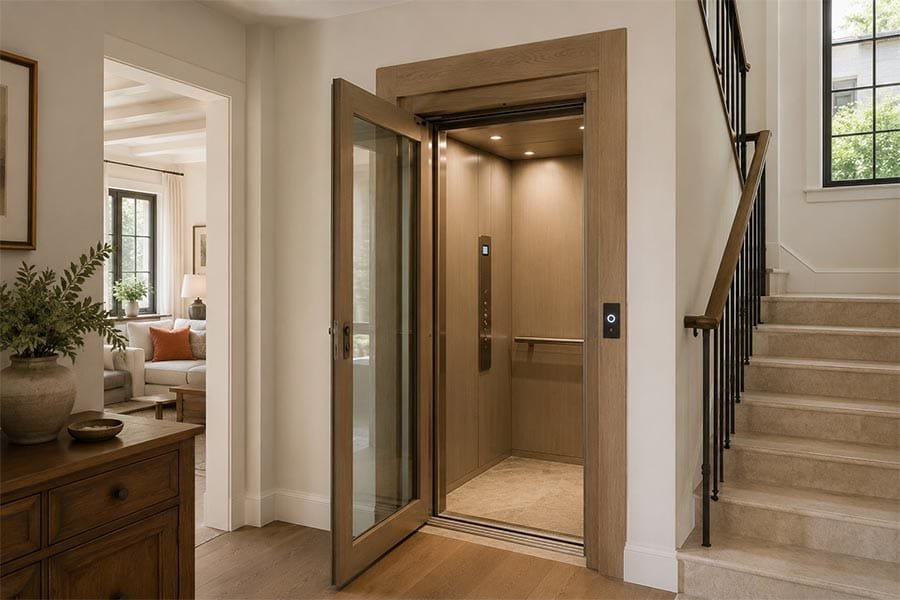
How to Choose the Right Home Elevator Size
Choosing the right dimensions involves more than selecting the smallest available model.
Consider the following factors before making your decision.
Number of Users
A larger family may benefit from a larger cabin that accommodates multiple passengers comfortably.
Available Space
Measure the installation area carefully and consider both the shaft and surrounding access space.
Future Accessibility
Planning for wheelchair access or aging family members can improve long-term usability.
Load Capacity
Choose an elevator that matches your expected daily use without oversizing the project unnecessarily.
Building Design
New homes offer greater flexibility, while existing buildings may require customized solutions.
Working with an experienced elevator manufacturer during the design stage helps ensure the best balance between comfort, performance, and space efficiency.
Common Mistakes When Planning Home Elevator Dimensions
Many installation problems can be avoided with proper planning.
Common mistakes include:
- Confusing cabin size with shaft size
- Ignoring pit depth requirements
- Forgetting overhead clearance
- Choosing a door that is too narrow
- Selecting the smallest possible cabin without considering future needs
- Failing to reserve maintenance space
Understanding these factors early can save time and reduce construction costs.
Frequently Asked Questions
What is the standard size of a home elevator?
Most residential elevators have cabin dimensions between 700 × 800 mm and 1100 × 1400 mm, depending on the intended capacity and application.
What is the smallest home elevator available?
Some compact models require a shaft of approximately 1000 × 1000 mm, making them suitable for homes with limited space.
How much space is needed for a home elevator?
Most home elevators require a shaft between 1200 × 1200 mm and 1800 × 1800 mm, along with pit depth and overhead clearance.
Can a home elevator be installed without a shaft?
Some shaftless or platform-style elevators can be installed without a traditional enclosed shaft, although they still require sufficient structural support and installation space.
What is the recommended door width?
A door width of 700–900 mm is common for residential elevators. Wider doors improve accessibility and convenience.
How deep should the elevator pit be?
Most home elevators require a pit depth between 200 mm and 500 mm, depending on the drive system and manufacturer specifications.
Can a home elevator accommodate a wheelchair?
Yes. Wheelchair-accessible models typically feature larger cabins and wider doors to provide safe and comfortable access.
# Final Thoughts
There is no universal home elevator size that fits every house.
The ideal dimensions depend on your available space, family size, accessibility requirements, and building design.
Understanding the difference between cabin dimensions, shaft dimensions, door width, pit depth, and overhead clearance will help you make an informed decision before construction begins.
If you are planning a residential elevator project, working with an experienced manufacturer from the early design stage can help optimize the layout, reduce installation costs, and ensure reliable long-term performance.
Need help choosing the right home elevator dimensions?
Our engineering team can provide customized layout recommendations based on your floor plan, travel height, and installation space. Contact us for professional advice and a tailored solution for your home.