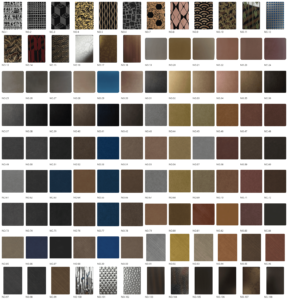
One hundred and eight stainless steel finishes, in nine processes and eleven colors.
Elevator finishes at a glance
Four groups, and the difference between them is how much of the light comes back.
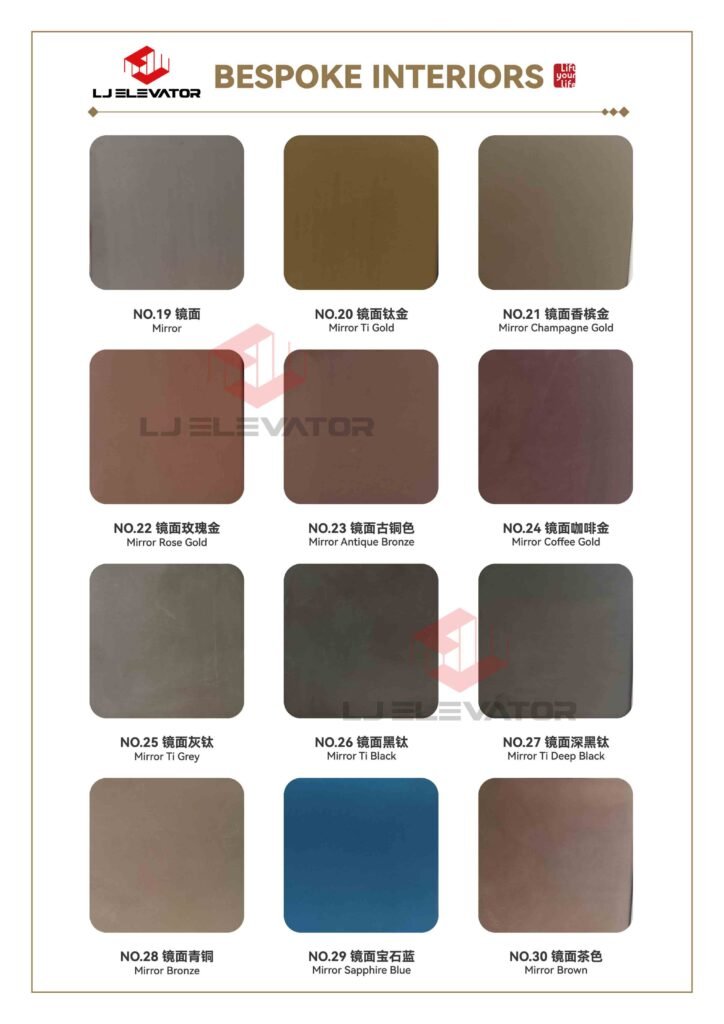
- Reflective — mirror (NO.19–30). The surface returns an image.
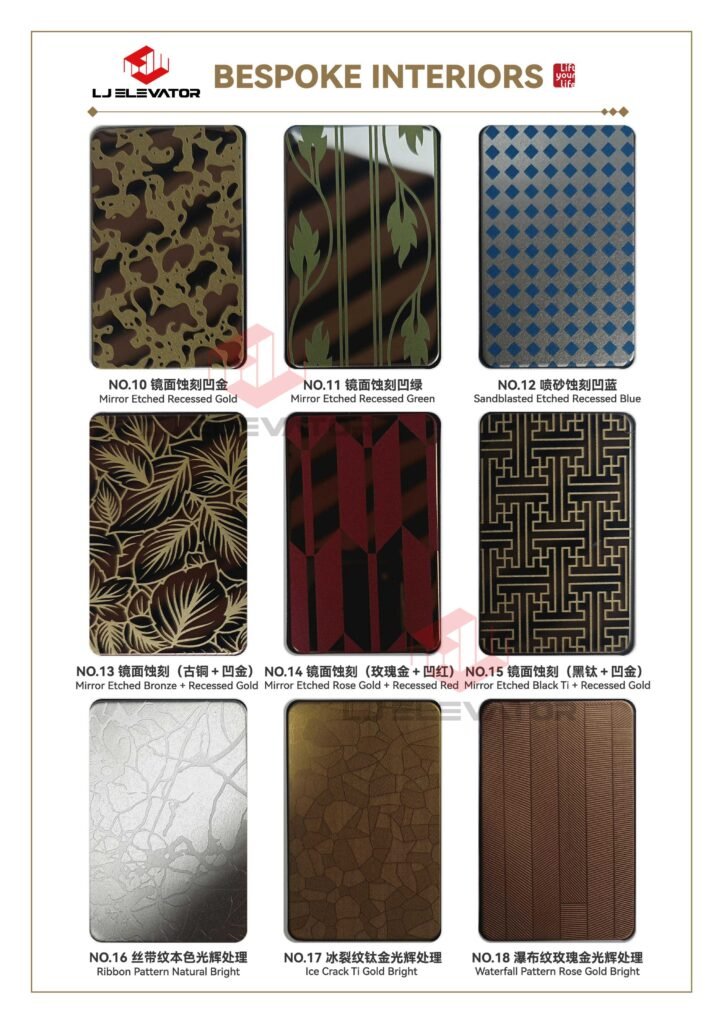
- Broken reflection — mirror etched (NO.1–18). The surface still shines, but the pattern scatters the image.
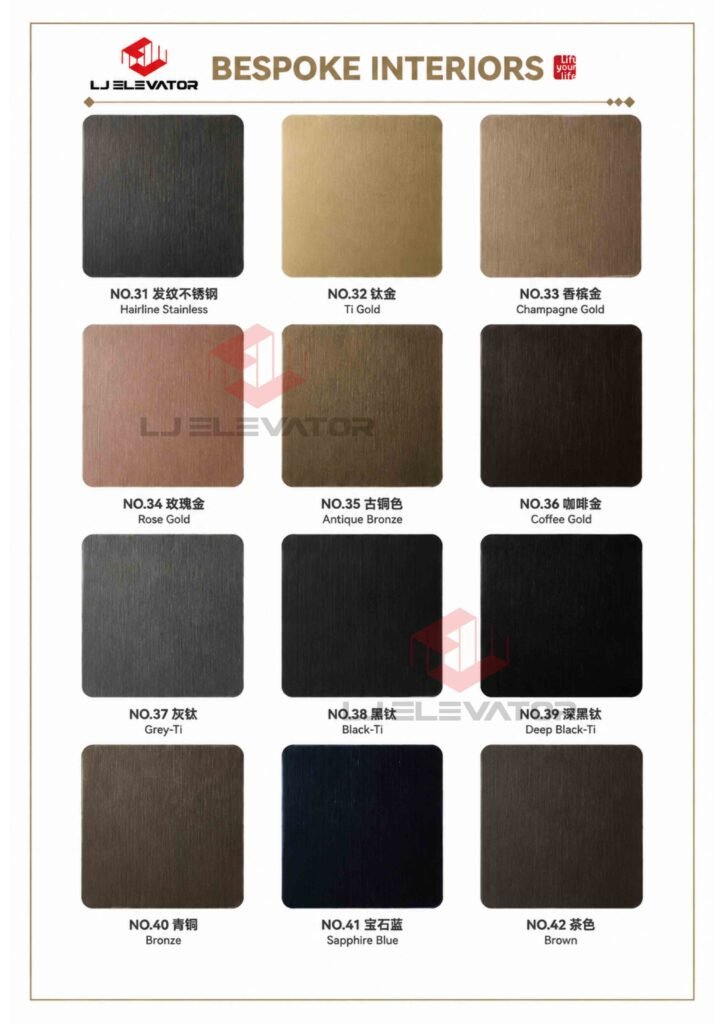
- Directional grain — hairline (NO.31–42) and 2B cross-brushed (NO.91–99). Fine parallel lines, running one way or crossing.
- Matte and relief — sandblasted (NO.43–54), apple sand (NO.55–66), tumbling (NO.67–78), embossed and antiqued (NO.100–108). No image, and in the last group no flat face either.
Anti-fingerprint (NO.79–90) sits outside the four: it is a coating applied over any of them.
What the swatches are for
The book covers the visible faces of a car and its landing doors. The elevator car wall panels — front return either side of the door, side panels, rear panel — the ceiling, the car door, the landing door and the skirting. Those faces together are the elevator cab interior panels, and the finish on them is the elevator cab interior finishes most enquiries are about.
Ceiling and floor are usually specified alongside: an elevator interior finishes scheme is not only elevator wall finishes, e o elevator floor finishes e elevator door finishes have to agree with them.
The book is also the reference for an elevator cabin interior design at drawing stage, for an elevator car interior design revision, and for an elevator cab refurbishment, where the existing car sets the limit on what can be re-faced.
Mirror — NO.19 to NO.30
Polished to full reflectivity. A mirror stainless steel face turns a wall into a second window: it returns the light, the ceiling and the wall opposite, so a small car reads wider and a low ceiling reads higher.
Twelve swatches — the natural mirror, then ten colours and the base again in the deeper tones. The reflection is the whole effect, and anything applied over it removes it.
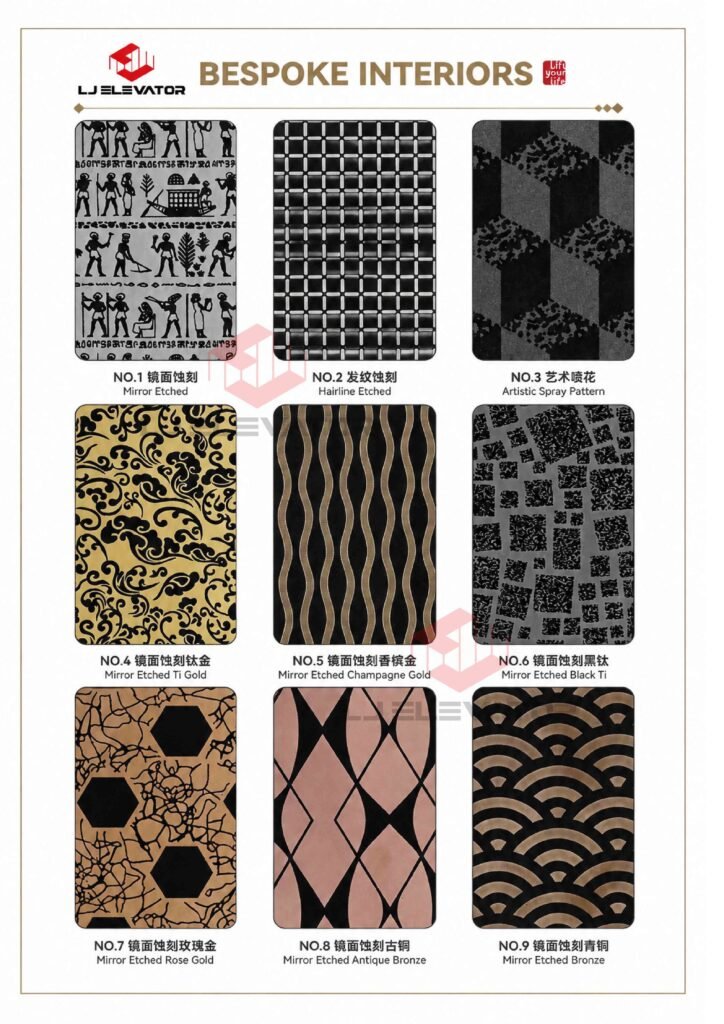
Mirror etched — NO.1 to NO.18
Um etched stainless steel face is acid-cut with a pattern. The surface still shines, but it no longer returns an image.
Eighteen swatches, and not one process:
- Plain and coloured etch — NO.1, NO.2, NO.4 to NO.9. A fine mirror or hairline etch, on natural stainless or over a colour.
- Artistic spray pattern — NO.3. A looser, hand-drawn register.
- Recessed etch — NO.10 to NO.15. Cut deeper, with a second colour inside the recess, and pairs such as bronze with recessed gold.
- Bright pattern — NO.16 to NO.18. Ribbon, ice crack and waterfall, which read as texture rather than as an image.
Hairline — NO.31 to NO.42
A fine, continuous abrasive grain running one way. The surface reads as metal at rest: the grain follows the sheet, so the panel has a direction but no pattern.
The most widely used finish in the book: hairline stainless steel is what most specifications mean when they simply say stainless.
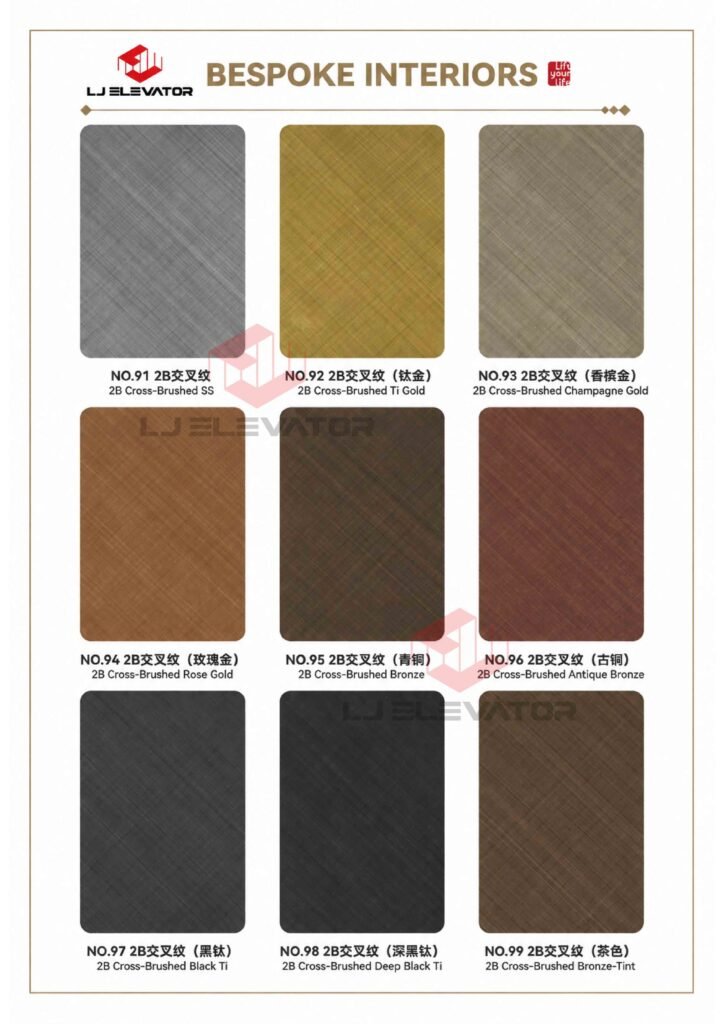
2B cross-brushed — NO.91 to NO.99
The base is 2B — cold-rolled, annealed and skin-passed — and the grain is brushed across the sheet rather than along it. The face is flat and low in sheen, with a faint change of direction where the light rakes across it.
Nine swatches, in the shorter colour set.
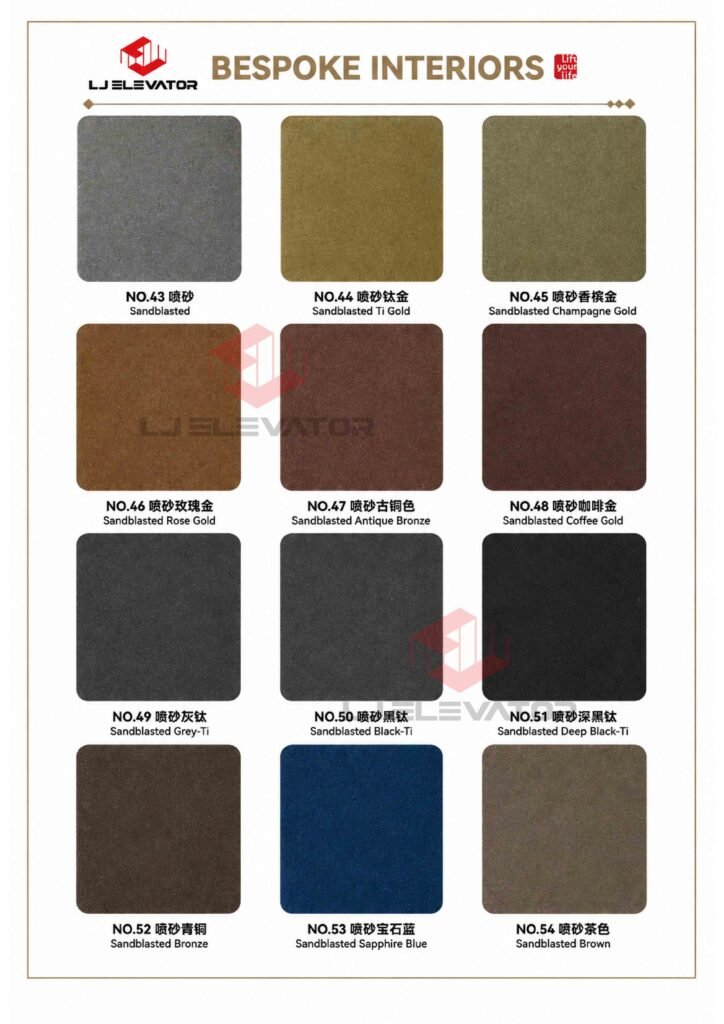
Sandblasted — NO.43 to NO.54
Abrasive blasted across the face leaves an even matte with no direction at all. Light scatters instead of reflecting, so the panel holds one tone from any angle and the reflection of a person disappears.
Twelve swatches.
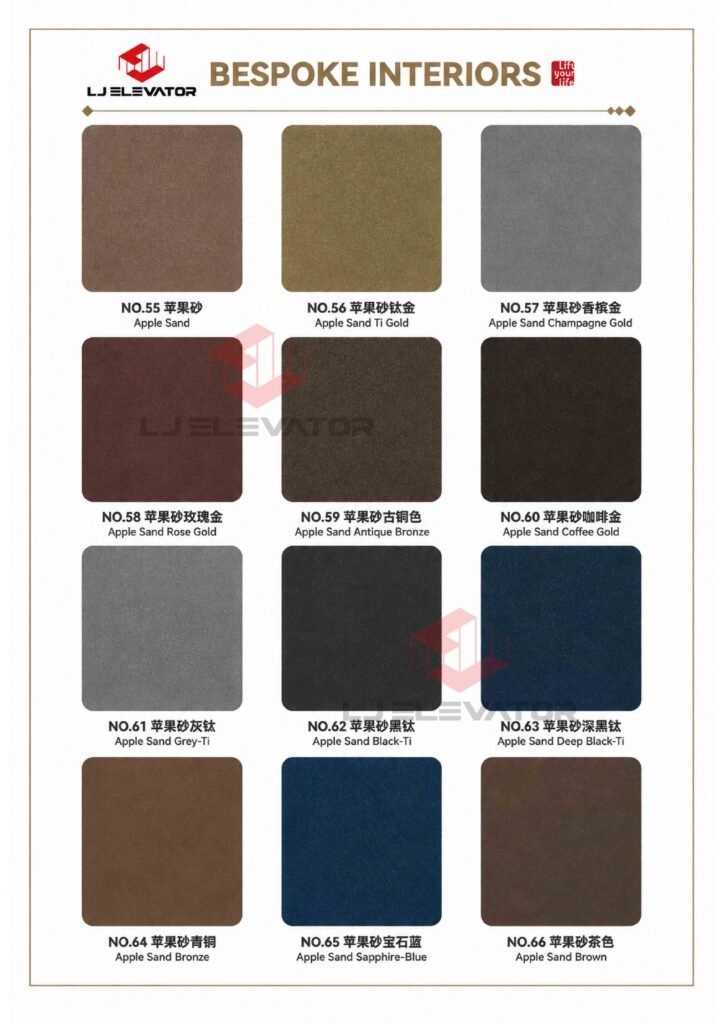
Apple sand — NO.55 to NO.66
A finer blast than sandblasting, which is why the two sit in separate families. The surface is smoother and more even, and the matte is shallower — so more of the colour underneath shows through.
Twelve swatches, in the same colour set as sandblasted.
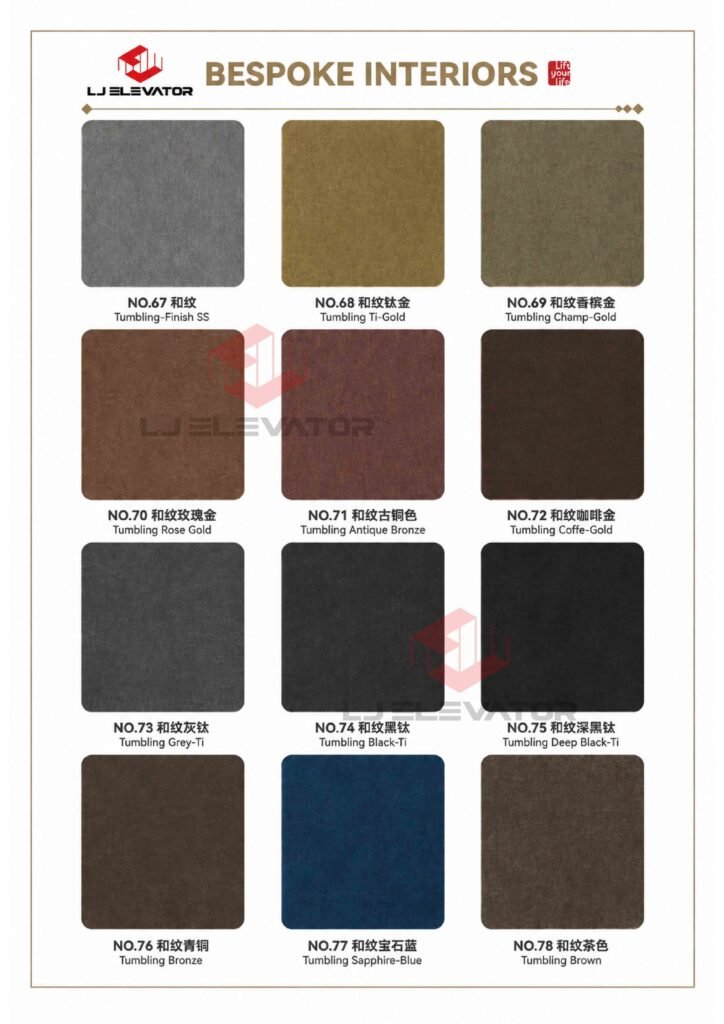
Tumbling — NO.67 to NO.78
A random, orbital swirl, laid down in overlapping passes. Unlike every other grain in the book, tumbling has no direction.
That is what gives it its look: a dense, soft sheen with no repeat to follow. It is also why the swirl is random by definition, and why two batches cannot be matched to each other.
Twelve swatches.
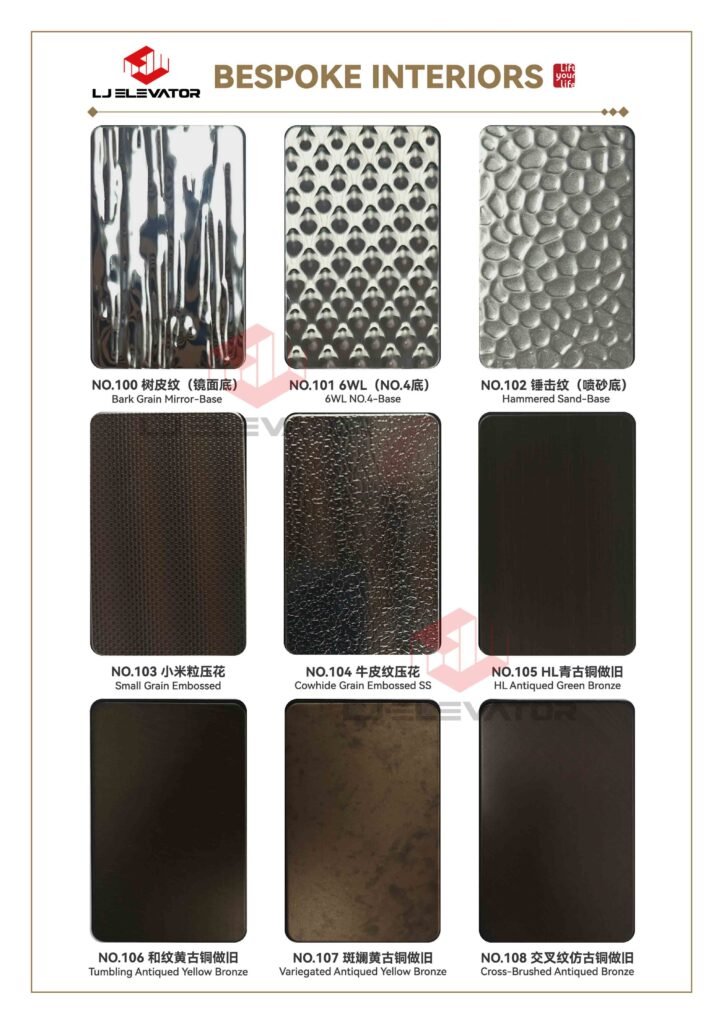
Embossed and antiqued — NO.100 to NO.108
The only family with real relief — a decorative stainless steel sheet in the literal sense, not a pattern printed on a flat face. Nine swatches, in three ideas:
- Embossed grain — bark (NO.100), 6WL (NO.101), hammered (NO.102), small grain (NO.103), cowhide (NO.104).
- Antiqued — a patina worked into the surface: HL green bronze (NO.105), tumbling yellow bronze (NO.106), cross-brushed bronze (NO.108).
- Variegated antiqued — NO.107, where the patina is deliberately uneven across the sheet.
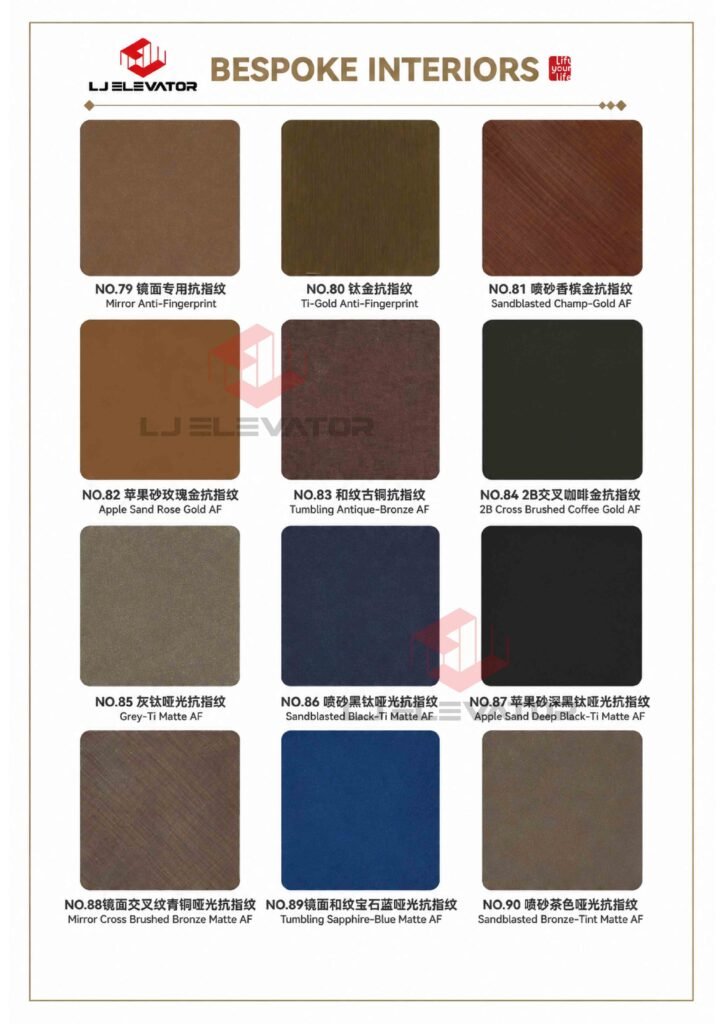
Anti-fingerprint — NO.79 to NO.90
Not a ninth surface. A coating applied over a base, and the twelve swatches show the same coating on different bases: mirror, sandblasted, apple sand, tumbling, 2B cross-brushed, grey Ti matte, and mirror cross-brushed.
This is the one family where the sample number matters more than the colour, because the base underneath decides how the face looks. Anti fingerprint stainless steel is a coated version of something else in this book, never a finish of its own.
Colours
Eleven colours run across the families: Ti Gold, Champagne Gold, Rose Gold, Antique Bronze, Coffee Gold, Grey Ti, Black Ti, Deep Black Ti, Bronze, Sapphire Blue and Brown.
The etched, 2B and textured groups use their own sets, so the number is the reliable reference. A stainless steel finish chart sorted by colour loses that, and an architectural hardware finishes chart sorted by product loses it too. This book keeps it in the number, which is why the same eleven colours still produce types of elevator finishes that behave nothing alike.
Cabins and landing doors
The book covers both, in the same finishes and the same numbering. Car wall panels and landing door faces come out of one reference, which is what keeps a lobby consistent from the door in the hall to the door in the car.
Ordering a finish
Quote the number. Elevator cab finishes named by colour alone are ambiguous — NO.32 is a Ti Gold hairline, while “Ti Gold” on its own could be any of six processes.
For the full book, ask for the elevator cabin design catalogue in print, as an elevator catalogue design pdf, or as the elevator design book pdf. Para elevator cab finishes samples, tell us which numbers you are looking at and we will send those.
FAQ
What do the numbers mean? NO.1 to NO.108 run through the book in order. A drawing or a quotation refers to the number, because a colour name does not identify a process.
Is hairline the same as brushed? Same family. Brushed is the general term for an abrasive grain; hairline is a fine, continuous, unidirectional grain, and it is the term used on elevator specifications.
Do all families come in all eleven colours? No. Mirror, hairline, sandblasted, apple sand and tumbling carry the full set. The etched, 2B cross-brushed and textured groups carry their own shorter sets.
What does anti-fingerprint change? It reduces the visible marks left by hands. It is a surface layer over the base finish, so the base still decides the look and the sheen.
Are the cabin and the landing door the same finishes? Yes — same book, same numbering. That is what allows a car and its landing doors to be specified from one reference.