How much does a stairlift cost compared to an elevator? A straight stairlift costs 2,000to8,000 installed. A curved one costs 8,000to20,000. A home elevator starts at about 35,000umdcumreach80,000 or more before site work. The elevator therefore costs four to ten times as much as a straight stairlift.
All figures in this article are in US dollars, taken from published US market prices.
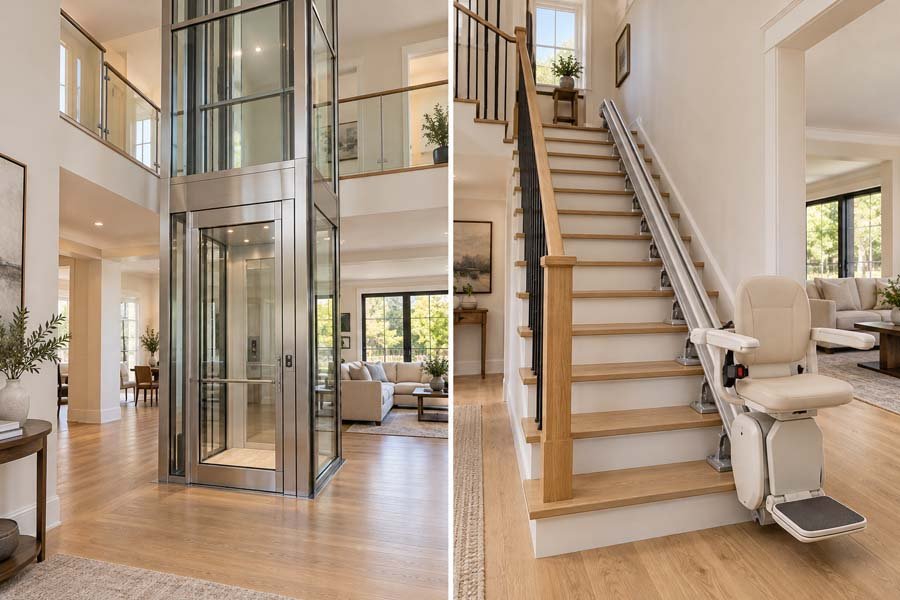
The short answer, in one table
| Stairlift (straight) | Stairlift (curved) | Elevador doméstico | |
|---|---|---|---|
| Typical installed total | $2,000–$8,000 | $8,000–$20,000 | $35,000–$80,000+ |
| Installation included? | Usually | Usually | Sometimes separate |
| Shaft or floor opening | Not applicable | Not applicable | $8,000–$15,000 if a shaft is built |
The elevator figure in the last row usually excludes site work, while the stairlift figure usually includes everything. Most published comparisons put these two numbers side by side without saying so.
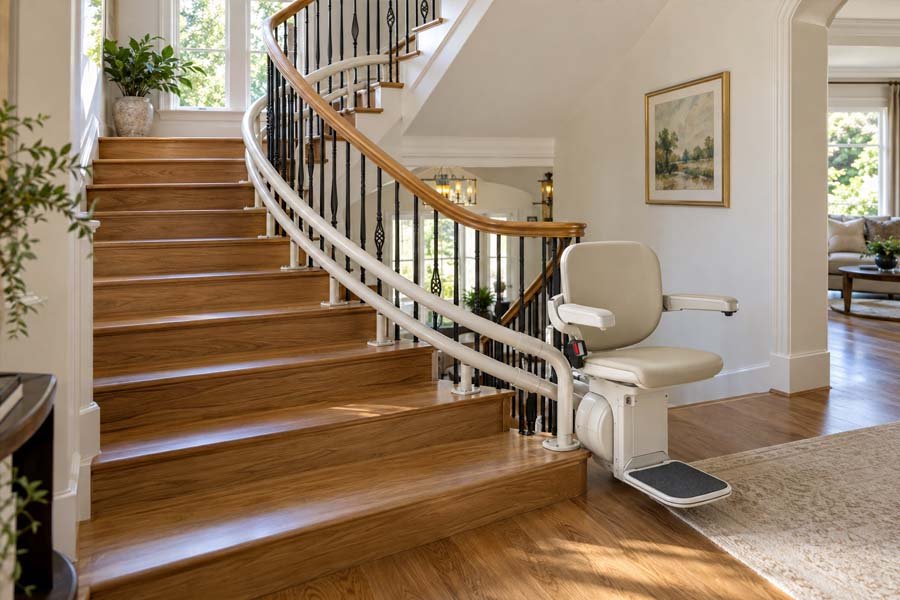
The straight stair lift cost figure sits near the bottom of the range. The curved stairlift cost figure sits in the middle of its own range, because the rail is measured and bent for one staircase. A $1,500 quote and a $20,000 quote are therefore not competing prices: one is a straight unit with the owner measuring the stairs, the other is a custom rail. A stairlift price comparison has to separate the two, because they are priced on different work.
Searches for stair lift vs elevator cost usually compare a straight stairlift against the cheapest elevator in the results, which are both the low end of their categories.
Why the two price ranges overlap so much
Published home elevator cost figures run from $10,000 to $100,000 because four different products share the name.
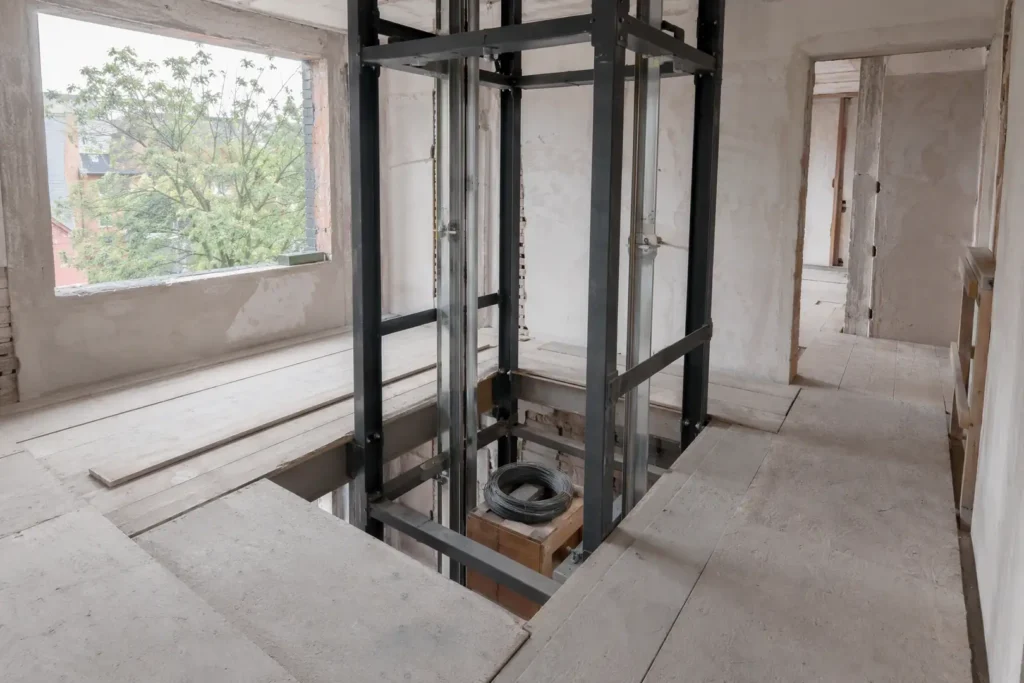
- Through the floor, no shaft. $35,000–$60,000 installed. The car travels in an opening cut through the floor slab, without an enclosure.
- Traditional, with a shaft. From $50,000. Requires a hoistway, plus a pit or machine space depending on the drive, and a landing at every level.
- Glass panoramic. From $80,000. Part of the price is the enclosure as a design element.
- Simplified imported units. $10,000–$25,000 for a two-storey unit. Figures at this level generally exclude local installation, site work and permits.
The stairlift side has the same spread. A $1,500 figure usually means the owner measured and installed the unit, or that labour was quoted separately. A $20,000 figure means a curved rail, a long run and a powered folding track.
Two consequences. Shaftless home elevator cost and through the floor elevator cost are priced differently from residential elevator cost and are worth searching separately. And when two answers to “how much does a stairlift cost installed” differ by a factor of five, the usual reason is that only one of them included labour.
Two published sources describe shaftless elevators in opposite terms: one calls them cheaper than a traditional elevator, the other calls them more expensive. The shaft and the equipment move in opposite directions. Removing the shaft reduces construction cost. Replacing a concrete hoistway with a self-supporting frame raises the equipment cost. Which effect is larger depends on local construction prices.
For that reason the dollar figures here are one worked example rather than a global price list. In a market with low labour cost and expensive imported equipment, an elevator’s installed total moves toward its equipment price and the gap with a stairlift narrows. Where site work is expensive, the gap widens. The ratio between the two products transfers between markets more reliably than the amounts.
What each quote actually includes
| Line item | Stairlift | Elevador doméstico |
|---|---|---|
| Equipment | Included | Included |
| Home survey and measuring | Usually included | Usually included |
| Installation labour | Usually included | Sometimes separate |
| Shaft, pit or floor opening | Not applicable | Usually excluded |
| Making good: floors, walls, ceilings | Not applicable | Usually excluded |
| Dedicated electrical circuit | Rarely needed | Usually required |
| Landing doors and frames | Not applicable | Sometimes optional |
| Permit, inspection, acceptance test | Rarely required | Usually required |
| First-year maintenance | Sometimes included | Sometimes included |
The stairlift cost with installation is easy to establish, because the product and half a day of labour are normally sold together; a stairlift installation cost quoted on its own is uncommon. A home elevator installation cost is harder, because the installation is a small building project. When a supplier gives a single figure for “how much does a home elevator cost to install”, the useful question is which rows of the table above that figure covers. Differences between two elevator quotes usually come from three or four rows.
Five-year and ten-year cost, side by side
The example below uses the middle of the published ranges for a two-storey house: a straight staircase, a straight stairlift at $4,500 installed, a two-stop elevator with a shaft at $55,000 including site work, annual servicing at $150 and $400 respectively. All figures are US dollars.
| Stairlift, straight | Home elevator, 2 stops | |
|---|---|---|
| Installed, year 0 | $4,500 | $55,000 |
| Servicing, 10 years | $1,500 | $4,000 |
| Consumables | Battery replacement, not included | Door and safety parts, not included |
| Ten-year total, excluding electricity | ≈ $6,000 | ≈ $59,000 |
For cost of home elevator vs stair lift, the ten-year ratio is about ten to one in a house of this type. Electricity is excluded from both columns because it is small enough not to change the comparison; the figures are given below.
Two variables change the result. In a new build the shaft is designed in and costs less than a retrofit. And the elevator figure stays the same whether one person uses it or four, which affects the cost per user rather than the total.
The lowest 2 floor home elevator cost comes from a two-stop configuration. Each additional stop adds a landing door, a set of interlocks, more rail and more wiring, so a three-stop machine costs closer to half as much again than a third more.
Maintenance and running cost
A stairlift is serviced once a year: battery, track, seat swivel and safety edges. Published stairlift maintenance cost is $100–$200 a year, and the visit takes under an hour.
Home elevator maintenance cost is usually quoted at $300–$500 a year for a residential unit, with some markets reporting $200–$500. Where there is no contract, home elevator service cost per visit is commonly $100–$300, and a contract is normally cheaper over ten years. Inspection fees are often separate.
The difference in cost follows the difference in equipment. A stairlift has a motor, a battery and a track; if it fails, the staircase is still usable. An elevator has a controller, a drive, door operators, locks and a car, and a stoppage between floors requires a technician.
The answer to “how much does a stairlift cost to run” is small. A straight stairlift moves for under a minute per trip and draws power mainly for charging. A 2022 UK trade measurement put a 13-step straight unit at £10–£15 of electricity a year. A hydraulic or traction elevator runs for seconds at a time and is idle for most of the day. Electricity is not a significant line in either case.
Permits, inspections, and the time cost
Do stairlifts need a permit? In a single-family house for personal use, usually not. The unit is fixed to the treads, plugs into an existing outlet and does not alter the structure. Where a permit is required it is typically $50–$200 and the supplier arranges it. Commercial buildings, shared stairwells and some HOA communities require approval.
An elevator is treated as regulated equipment in most jurisdictions: a permit before work starts, an acceptance test at completion, and periodic inspection afterwards. Residential elevator inspection requirements vary by state and country, but the pattern is an inspection at completion followed by annual or biennial visits, with the certificate kept with the machine. Residential elevators fall under ASME A17.1/CSA B44; stairlifts under ASME A18.1.
Installation time also differs. A stairlift is fitted within a day. An elevator takes days to weeks on site, in addition to design, permit processing and the sequencing of other trades. Where the need is immediate, this difference usually decides the purchase before price is discussed.
What pushes a stairlift price up or down
- Straight or curved. A straight rail is cut from stock. A curved rail is measured on site, drawn, bent and test-fitted.
- Run length and number of flights. Track is priced by length, and two flights cost more than one.
- Turns and landings. A 90-degree turn, a 180-degree turn or a mid-landing requires custom rail geometry. Landings also add cost because the unit has to stop and restart cleanly.
- Folding method. Manual folding is standard. Power folding rail, power swivel seat and power footrest add cost, and are useful where a folded unit would block a doorway.
- Staircase construction. Open treads, glass balustrades and stairs built against an external wall may need brackets, a floor-mounted post or a different fixing method.
- Power supply. A socket near the lower landing avoids cable runs.
- Local labour. Installation takes half a day for a straight unit, but labour rates vary by a factor of three between markets.
- New or reconditioned. Reconditioned stairlift cost runs $1,000–$10,000 depending on the model. Reconditioned units are rarely available for curved stairs, because the rail was bent for another house.
Narrow staircases are a normal application rather than a limitation. A stairlift for narrow stairs sits on the treads instead of beside them, so the width required is the tread width plus the folded seat. What limits a narrow staircase is the clear width remaining when the unit is folded, not the unit itself.
What pushes an elevator price up or down
- A shaft, or no shaft. A hoistway is the largest single item at $8,000–$15,000 when it has to be built. A self-supporting unit avoids it but costs more as equipment.
- Shaft material. Concrete block, steel frame, aluminium and glass, or structural glass. Glass can double the enclosure cost and is chosen for appearance.
- Drive type. Hydraulic requires a pit and usually a machine space. Traction requires headroom above the top landing. Screw and nut drives need neither, which is why they are common in retrofits.
- Number of stops. Elevator cost per floor is not linear, because each stop adds a landing door, interlocks, rail and wiring.
- Doors. Manual or automatic, one set per landing. Automatic doors at every level are a significant share of the total.
- Car size and finish. A standard stainless steel car is the baseline. Timber, glass, lighting and custom ceilings raise the price considerably.
- Espaço livre e fosso. In a finished house, ceiling height above the top landing and available pit depth determine which drive types are possible.
- Electrical supply. A dedicated circuit is normally required, and in some markets a three-phase supply. Providing one is separate work.
- Transport and lifting. Moving a car, controller and rail sections into a finished house takes time and equipment, particularly with narrow access or no lift.
- Permits and acceptance testing. Fees are small; design changes required by an inspector are not.
- Service network. In export markets, spare parts availability and response time affect total cost more than a small difference in equipment price.
Site conditions that move the number most
Five site facts shape a quotation before any of the above. Checking them costs nothing.
- Can the floor be opened? Beam direction and load-bearing walls determine where a shaft can go.
- How much headroom above the top landing? Traction drives need it, and many retrofit houses do not have enough.
- Is there a pit, or space for one? Hydraulic drives need depth below the lower landing.
- Can the equipment be brought in? Measure the doorways and the turn at the bottom of the stairs.
- How wide is the staircase? For a stairlift, the folded clearance and the remaining escape width decide whether it fits.
The space you pay for is not the same kind of space
Stair lift staircase width requirements are published inconsistently. Minimum widths range from 26 to 30 inches, with more for curved rails, and folded protrusion is quoted from 7.5 to 16 inches. The folded width depends on whether the seat, arms and footrest fold, whether the rail folds at the bottom, and which side the wall is on. The staircase also has to retain enough clear width for escape; 36 inches is the figure most residential codes work from, and a unit that leaves less may not comply even where it fits.
Residential elevator dimensions are more predictable. A shaft is about 4 by 5 feet, a car about 3 by 4 feet, and each door needs 36–48 inches of clear floor in front of it. A shaftless unit fits in roughly 4 by 4 feet.
The two take different kinds of space. A stairlift occupies width inside a stairwell, which cannot be used or sold. An elevator occupies floor area, which has a value. At $200 per square foot (USD), a 20 square foot shaft represents about $4,000 of floor value. In markets where floor area is cheap this has little effect on the comparison; where it is expensive, it narrows the gap.
The one question that decides it before price
The first question is whether the user can get into the seat and out of it unaided. A stairlift requires the user to move from standing to sitting and back, with or without help. Where that is possible, a stairlift works. Where it is not, a stairlift is unsuitable regardless of price, and the alternative is a platform lift that carries the wheelchair itself. That is a third product with its own cost range of $5,000–$20,000 and its own space requirements, so stair lift vs platform lift is a separate comparison.
An elevator places no requirement on the user. It carries a wheelchair, a walker, two people, a pram or a week of shopping. This changes the cost per user. A $6,000 stairlift used by one person costs about $600 a year over ten years. A $59,000 elevator used by four people costs about $1,475 a year each. The elevator remains more expensive, but the difference in cost per user is smaller than the difference in purchase price.
How to choose, step by step
In a specific house, the question of “how much does a stairlift cost compared to an elevator” requires six measurements rather than two prices. Most elevator vs stair lift for home decisions come down to them, and a home lift cost calculator cannot supply any of them, because the figures that matter are on site.
- Test the transfer. Can the user stand, turn and sit without help? If not, price an elevator or a platform lift instead.
- Count the users. A stairlift carries one person at a time on one staircase.
- Count the levels. Two floors with one staircase is the simplest case. Three or more levels, or two separate staircases, change both product and price.
- Measure three things. Floor-to-floor height, staircase width, and the space available for a shaft.
- Set a time horizon. Under about two years, the lower-cost option usually suits. Over ten years, the calculation favours the elevator.
- Price ten years, not the purchase. Add servicing and consumables; electricity can be left out. This is the comparable stair lift vs elevator cost figure.
Three common situations and their usual outcome:
- One person, one staircase, limited budget. A straight stairlift at $2,000–$8,000, fitted in a day.
- A family in a villa, several floors, long-term occupancy. A home elevator at $35,000–$80,000, which carries people and goods.
- A wheelchair user, or mobility that will decline. An elevator, or a platform lift where budget or space rules out a shaft. Not a stairlift.
When each one is the wrong purchase
A stairlift is unsuitable where:
- The user cannot transfer from a wheelchair to a seat without help.
- A wheelchair, rather than a person, has to move between floors.
- Three or more levels are in daily use and each would need its own unit.
- The staircase cannot keep the required escape width once the unit is folded.
- The house will be sold within a few years. Stairlifts are usually removed, and removal and making good carry a cost.
An elevator is unsuitable where:
- One person, a short or uncertain need, and a fixed budget ceiling.
- There is no shaft footprint, the slab cannot be opened, or headroom above the top stop is insufficient.
- The difficulty is limited to using stairs, and the user can still transfer independently.
- The value of the house is low relative to the cost of the installation.
The fourth point is often overlooked. An elevator is a fixture, and its cost has to be proportionate to the building. Comparing stairlift vs home elevator for a household with a wheelchair user addresses the wrong question, because the transfer requirement decides the outcome before price is considered.
FAQ
How much does a stairlift cost compared to an elevator?
A straight stairlift installed costs $2,000–$8,000, a curved one $8,000–$20,000, and a home elevator $35,000–$80,000 before site work. The elevator is normally four to ten times the price of a straight stairlift.
How much does a stairlift cost with installation?
Straight: $2,000–$8,000, usually including installation. Curved: $8,000–$20,000, because the rail is made for one staircase. A figure near $1,500 usually means the owner measured and installed the unit, or that labour was excluded.
How much does a home elevator cost for a two-storey house?
$35,000–$80,000 installed with a shaft, in most published ranges. A through-the-floor unit without a shaft is $35,000–$60,000. Figures below $25,000 generally cover equipment only.
Why do two elevator quotes differ so much?
Usually because they cover different items: shaft, floor opening, making good, landing doors, electrical work and permit. A difference of $20,000 between quotes for the same machine is normal.
Do I need a permit for a stairlift?
In a single-family house for personal use, usually not. Commercial buildings, shared stairwells and some HOA communities require approval. A permit, where needed, is $50–$200. An elevator almost always requires a permit and a final inspection.
Can a stairlift carry a wheelchair?
No. A stairlift carries a seated person, and the wheelchair stays at one level. Moving a wheelchair between floors requires a platform lift or an elevator.
How long do these systems last?
Service life depends on the number of trips and on maintenance, and no single figure applies across markets. The difference is structural: a stairlift is a domestic appliance, usually replaced when the house changes hands or the need ends, while an elevator is capital equipment designed for decades of service with maintenance records and periodic inspection. Cost per year of use is a more useful comparison than purchase price.
Choosing between them
A photograph of the staircase, the floor-to-floor height and the staircase width are enough for a preliminary answer before anyone visits the site. We will say which option is likely to cost less, and where the answer is a stairlift we will say so; we do not supply stairlifts.